|
 |
 |
 |



 |
|
 |
|
 |
|
 |
|
 |
|
 |
|
 |
|
 |
|
 |
|
 |
|
 |
|
 |
|
 |
|
Working Paper 9
Jobs, Revenues, and Taxes from Timber Harvest;
|
|||||||||||||||||||||||||||||||||||||||||||||||||||||||||||||||||||||||||||||||||||||||||||||||||||||||||||||||||||||||||||||||||||||||||||||||||||||||||||||||||||||||||||||||||||||||||||||||||||||||||||||||||||||||||||||||||||||||||||||||||||||||||||||||||||||||||||||||||||||||||||||||||||||||||||||||||||||||||||||||||||||||||||||||||||||||||||||||||||||||||||||||||||||||||||||||||||||||||||||||||||||||||||||||||||||||||||||||||||||||||||||||||||||||||||||||||||||||||||||||||||||||||||||||||||||||||||||||||||||||||||||||||||||||||||||||||||||||||||||||||||||||||||||||||||||||||||||||||||||||||||||||||||||||||||||||||||||||||||||||||||||||||||||||||||||||||||||||||||||||||||||||||||||||||||||||||||||||||||||||||||||||||||||||||||||||||||||||||||||||||||||||||||||||||||||||||||||||||||||||||||
| Table ES-1. Employment, Economic Output, and Tax impacts generated by one million board feet of annual timber production in Washington State (employment in person-years, output in millions of 2004 dollars calibrated to the Washington State Input-Output Model NAICS). |
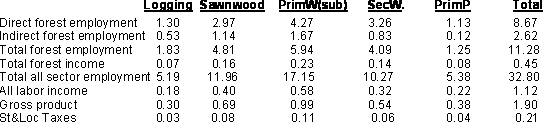 |
Table ES-2, presented below, summarizes the average total annual employment and revenue impacts from timber harvest in Washington from 1998 through 2004. Total jobs and economic benefits for the logging sector have been calculated based upon an average annual harvest of about 3.9 billion board feet. Processing jobs are based upon the total harvest net of log exports which averaged approximately 660 million board feet per year. Paper employment, as a consequence of timber harvest, is considered to be fifty percent of total state paper employment since approximately half of the state paper production is from chip supplies imported from out-of-state suppliers or from recycled material. Total direct and indirect employment was found to be 109,253 jobs with total labor income of $3.7 billion and an average annual wage of $34,000. Forest industry annual wages average $39,000 with a low for the furniture sector of $30,000 and a high for the paper industry of $60,000. The average annual Gross State Product (GSP), which includes labor income, business taxes, and capital income, resulting from timber harvest, was found to be $6.3 billion with State and Local Taxes equal to around $713 million per year. The average annual Gross State Product for Washington from 1998-2004 was $226.1 billion. The forest industry contributed about 3% of GSP during that period.
Table ES-2. Total Jobs and Outputs/Total Harvest MMBF/YR 1998-2004 Ave (employment in person-years, output in millions of 2004 dollars calibrated to the Washington Input-Output Model NAICS). |
 |
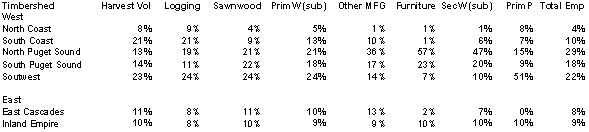
Table ES-3 shows a summarized distribution taken from this analysis of forest industry jobs by sector as a percentage of state totals for the Westside verses the Eastside of Washington. Comparisons of percentages by timbershed for harvest volumes and forest industry jobs are shown in Table ES-4. The west contributes 79% of the total state timber harvest volume but benefits from 83% of total forest industry employment. Note that five out of the seven timbersheds contribute a larger percentage share of state timber volume than comes back in relative employment benefit. The counties within these timbersheds are generally considered to be the more rural areas of the state. The more urban Puget Sound area, which has historically been the distribution and transportation center for Washington , accounts for only 27% of the timber harvest but benefits from 47% of the jobs. While forest industry employment and revenue streams may leverage higher as a contributor to less diverse rural economies, this analysis shows that almost half of the actual economic benefit occurs in more urban areas.
Table ES-3. Forest Industry Employment and Economic Impact West and East as a Percentage of State Totals by Sector |
 |
Table ES-4. Forest Industry Employment by Sector by Timbershed and Harvest Volumes by Timbershed as a Percentage of State Totals |
 |

Impacts of treatment alternatives
Estimates of alternative treatment employment impacts were developed from relative harvest cost comparisons provided by the Washington Department of Natural Resources and a survey of Washington Contract Loggers Association membership. For this demonstration, the average regeneration harvest cost per thousand board feet (MBF) of logs removed is assumed as a baseline and given the relative value of 1. Average selection harvest costs were found to be 1.89 times more costly than the baseline regeneration harvests. Average commercial thinning costs were found to be 2.32 times more costly than the baseline regeneration harvests. Long rotation harvests are assumed to have the same cost as the baseline. Assuming that operation cost increases are accompanied by proportionate worker-hour increases, then the estimated cost increases can be used to adjust the economic multipliers. Adjustments were also made to reflect effects on secondary and primary paper processors.
Table ES-5. Adjusted employment impacts for different treatments for Western Washington. |
 |
Table ES-6. Adjusted employment impacts for different treatments for Eastern Washington. |
 |
Returns from state timber sales to trust beneficiaries
Stumpage revenue generated from DNR timber sales has a uniquely powerful impact on state wealth as it is reinvested within the state; approximately seventy-five percent of stumpage revenues are reinvested for the public good (as returns to trust beneficiaries) in government projects and services in Washington. An estimate of the added benefits provided by DNR stumpage revenues was calculated based upon the assumption that DNR revenues provide public services that otherwise would require tax increases therefore these revenues function as additional state labor income. The average annual timber volume harvested from state forests for the years 1998 through 2004 was 562 million board feet. The average stumpage return was $329/MBF. Total average annual revenue exceeded $185 million with seventy-five percent returned to the trust beneficiaries and the state economy equal to $134 million per year. To model the impact of the addition to the state economy from returns to trust beneficiaries, we added an additional labor income benefit of $246,874 per million board feet of harvested timber to state baseline multipliers and calculated the cumulative impact based upon an average annual DNR timber removal from 1998-2004 of 562 MMBF (Table ES-7,8,&9; employment in person-years, output in millions of 2004 dollars calibrated to the Washington Input-Output Model NAICS).
Table ES-7. Annual economic outputs from DNR timber sales without re-investment of trust revenues. |
 |
Table ES-8. Annual economic outputs from DNR timber sales with re-investment of trust revenues. |
 |
 |
The economic multipliers used in the analysis are best current estimates grounded by surveys, census data, and engineering estimates linked to harvest volume inputs and developed with the Washington Input-Output Model.
Table of Contents
Click here to view the PDF version of Working Paper 9 (800 KB)List of Figures
| Figure 1 | Total Washington timber harvest and total forest industry jobs/year 1998-2004. |
| Figure 2 | Total Washington timber harvest and forest industry jobs/MMBF/year 1998-2004. |
| Figure 3 | Average forest industry Jobs/MMBF/YR timber harvest by timbershed 1998-2004. |
| Figure 4 | Average forest industry Jobs/MMBF/YR timber harvest by sector and by timbershed (1998-2004). |
| Figure 5 | Woods Worker Wages (1995-2007) |
| Figure 6 | Health care benefits provided by Washington logging companies. |
| Figure 7 | Logging company future goals |
| Figure 8 | Lumber to Log Overrun for Western and Eastern Washington Sawmills. |
| Figure 9 | Number of WA Pulp Mills and Pulp Export Facilities & Total Annual Production 1989 - 2002. |
| Figure A1 | Western Washington Timbersheds |
| Figure A2 | Eastern Washington Timbersheds |
| Figure A3 | Washington Forest Industry Employment by Sector 1976-2004. |
| Figure A4 | WA Forest Products Jobs/MMBF/Year by Sector and Timbershed (1998-2004) |
| Figure A5 | Washington Lumber Production, Timber Harvests, and Log Exports 1992-2002. |
| Figure A6 | Washington Lumber Production and Forest Indiustry Employment 1992-2002 |
| Figure A7 | Washington Sawmills by Size Class and Total Production |
| Figure A8 | Total Cost of Materials and Total Value of Shipments for WA Wood Products Industries 2005 |
List of Tables
| Table ES-1 | Employment, Economic Output, and Tax impacts generated by one million board feet of annual timber production in Washington State |
| Table ES-2 | Total Jobs and Outputs/Total Harvest MMBF/YR 1998-2004 |
| Table ES-3 | Forest Industry Employment and Economic Impact West and East as a Percentage of State Totals by Sector |
| Table ES-4 | Forest Industry Employment by Sector by Timbershed and Harvest Volumes by Timbershed as a Percentage of State Totals |
| Table ES-5 | Adjusted employment impacts for different treatments for Western Washington. |
| Table ES-6 | Adjusted employment impacts for different treatments for Eastern Washington. |
| Table ES-7 | Annual economic outputs from DNR timber sales without re-investment of trust revenues. |
| Table ES-8 | Annual economic outputs from DNR timber sales with re-investment of trust revenues. |
| Table ES-9 | Difference in annual economic outputs from DNR timber sales with re-investment of trust revenues. |
| Table 1 | Washington Timbersheds |
| Table 2a | Average annual employment by sector and totals (1998-2004) per MMBF/YR for each timbershed. |
| Table 2b | Average annual employment by sector and totals (1998-2004) per MMBF/YR for state region and the state. |
| Table 3 | Employment, Economic Output, and Tax impacts generated by one million board feet of annual timber production in Washington State |
| Table 4 | Employment, Economic Output, and Tax impacts generated by one million board feet of annual timber production in Washington State |
| Table 5 | Total Jobs and Outputs/Ave Total Harvest MMBF/YR 1998-2004 Ave |
| Table 6 | Adjusted manufacturing employment multipliers as a result of 1998-2004 average log exports. |
| Table 7 | Forest Industry Employment and Economic Impact West and East as a Percentage of State Totals by Sector |
| Table 8 | Forest Industry Employment by Sector by Timbershed and Harvest Volumes by Timbershed as a Percentage of State Totals |
| Table 9 | Total State Jobs and Outputs/ MMBF/YR and Total Jobs and Outputs/ Total Harvest MMBF/YR 1998-2004 Ave. |
| Table 10 | Total Jobs and Outputs/ MMBF/YR and Total Jobs and Outputs/Total Harvest 1998-2004 forWestern Washington and Eastern Washington Ave. |
| Table 11 | Total Jobs and Outputs/ MMBF/YR and Total Jobs and Outputs/Total Harvest 1998-2004 for West Timbersheds: North Coast and South Coast Ave. |
| Table 12 | Total Jobs and Outputs/MMBF/YR and Total Jobs and Outputs/Total Harvest 1998-2004 for West Timbersheds: North Puget Sound and South Puget Sound Ave. |
| Table 13 | Total Jobs and Outputs/Ave MMBF/YR and Total Jobs and Outputs/Ave Total Harvest MMBF/YR 1998-2004 for West Timbershed: Southwest. |
| Table 14 | Total Jobs and Outputs/ MMBF/YR and Total Jobs and Outputs/ Total Harvest 1998-2004 for East Timbersheds: East Cascades and Inland Empire Ave. |
| Table 15 | Washington comparative harvest costs by treatment type with cost multipliers developed with regeneration harvest cost as the baseline. |
| Table 16 | Key employment impact changes to characterize treatment differences based on comparative processing costs and changes to manufacturing activities relative to the base for Western Washington. |
| Table 17 | Adjusted employment impacts for different treatments for Western Washington. |
| Table 18 | Key employment impact changes to characterize treatment differences based on comparative processing costs and changes to manufacturing activities relative to the base for Eastern Washington. |
| Table 19 | Adjusted employment impacts for different treatments for Eastern Washington. |
| Table 20 | Total employment, economic output, and tax impacts for treatment alternatives as generated by one million board feet of annual timber production for Western Washington |
| Table 21 | Total Employment, Economic Output, and Tax impacts for treatment alternatives as generated by one million board feet of annual timber production for Eastern Washington |
| Table 22 | Annual harvest yields in million board feet by treatment type and management regime for the forestlands within the OESF on the North Coast of the Olympic Peninsula. |
| Table 23a | Total Jobs and Outputs/MMBF/YR - DNR Integrated Management |
| Table 23b | Total Jobs and Outputs/MMBF/YR - Regeneration Harvest Only |
| Table 24a | Total Jobs and Outputs/ 94.687MMBF/YR - DNR Integrated Management |
| Table 24b | Total Jobs and Outputs/ 94.687 MMBF/YR - Regeneration Harvest Only |
| Table 25 | Volume and value of DNR timber removed 1998-2004 with approximated average return to trust beneficiaries per 1 million board foot of timber sold. |
| Table 26 | Annual economic outputs from DNR timber sales without re-investment of trust revenues. |
| Table 27 | Annual economic outputs from DNR timber sales with re-investment of trust revenues. |
| Table 28 | Difference in annual economic outputs from DNR timber sales with re-investment of trust revenues. |
| Table 29 | Washington Comparative Harvest Costs 2007 & 1996 in $/MBF |
| Table 30 | Availability of skilled mill workers |
| Table 31 | Summary statistics for Washington sawmills, 1981-2005. |
| Table A1 | Area of timberland by owner and land class in Washington. |
| Table A2 | Washington Timbersheds |
| Table A3 | The New NAICS Hierarchical Structure. |
| Table A4 | Sources of Input Data for the Washington Input-Output Model (NAICS) |
| Table A5 | The 39 Industrial Sectors in the Washington Input -Output Model (NAICS) |
| Table A6 | Forest Industry and Wood Processing Sectors by NAICS Classification Codes with modeling assumptions and selection criteria. |
| Table A7 | Forest Industry and Wood Processing Sectors by NAICS Classification Codes with estimated annual and average employment. |
| Table A8 | Average Annual Wages by Sector for the Forest industry from I-O Analysis(2004 $) |
| Table A9 | Average Annual Wages by Sector from Quarterly Census of Employment and Wages, Employment Security Department |
| Table A10 | Washington Economy 2003-2004 |
Introduction
A Changing Forest Economy
The development of the forest industry in Washington spans a history of rapid transition from naturally endowed and commonly held forest resources to managed forests in a complex mixture of public and private ownerships. One hundred years ago, good timber sold for $4 per thousand board feet (MBF) and $30,000 was enough build a sawmill (Andrews 1957). In 1910, Washington mills produced four billion board feet of lumber; most of which was shipped via rail and water to other states and countries. At that time Washington was the largest lumber-producing state in the United States (U.S.). The largest saw mill in the world was located at Port Blakely. Lumber production provided 61% of all manufacturing jobs and was an important determinant in the region's economic growth. Export of Washington 's rich timber resources induced extensive investment in regional distribution and transportation facilities that in turn quickened the pace of in-migration. New residents found forest products employment to be readily available with wages significantly higher than the national average. The mechanized nature of forest products processing led to growth of repair and maintenance industries that evolved into specialized machinery producers. Prosperity created a growing demand for locally produced goods and services; encouraging investment in domestic infrastructure including education. Transportation centers evolved quickly into cities. The Seattle population was 237,000 in 1910; equivalent to 21% of the state total of 1,142,000 just twenty years after statehood (Tattersol 1960).
One hundred years later, Washington annual lumber production has increased to approximately six billion board feet per year (BBF/YR) making the state the second largest producer in the U.S. behind Oregon . The largest sawmill in the world is now located in British Columbia . As it was in 1910, more than 80% of Washington-produced lumber is sold out-of-state. But, gone now is the expansionist philosophy of property ownership and natural resource exploitation that facilitated the rapid development of the Washington economy in the early twentieth century. In more recent years, concerns about species habitats and old growth protection have resulted in court injunctions and policy shifts that have caused disruptions to timber harvests and processing activities. In 1988, the timber harvest from National Forests in Washington State was 1.5 BBF/YR. In 2002, the federal harvest in Washington was 72 million board feet per year (MMBF/YR); less than 5% of the 1988 level. Timber harvest levels were reduced on Washington Department of Natural Resources (DNR) forestlands from 826 million board feet in 1988 to 457 million in 2002; a 45% decline.
As a result of dramatic reductions in public timber harvests, during the period from 1988 to the present, many sawmills, pulp mills, and veneer mills in Washington , unable to secure sufficient log supplies or to respond to rapidly shifting markets, closed operations. Forest industry employment dropped by more than 10,000 ( Warren 2000, 2005) creating downstream economic impacts that rippled through the state economy. However, the consequences of changes in timber supply were more profound than closed businesses and lost jobs; a total restructuring of the forest products industry occurred which produced some seemingly incongruent outcomes such as increases in annual state lumber production coincident with mill closures (Bergvall and Gedney 1970, Bergvall et al. 1979, Larsen 1992 & 2003, Perez-Garcia 2005). In 2006, forest industries provided 11% of Washington 's manufacturing jobs (Eastin et al. 2007). Seattle population has increased to 583,000; equivalent to only 9% of Washington total population of 6,396,000, but the Seattle metropolitan area, which didn't exist in 1910, has grown to support a population of 3,264,000; equivalent to 51% of the state total (U.S. Census).
Input-Output Analysis
Attempts to give precise form to the effects of expansion and contraction of regional economies, such as those described by the Washington examples above, have been made by scholarly economists through the years. Perhaps the most prominent approach is that of "inter-industry" or "input-output" analysis (Leontief 1936, Isard 1960, Leontief 1966, Yan 1969, Hewings 1985). Harvard University Professor, Wassily Leontief, was awarded the Nobel Prize in Economics in 1973 for his work, beginning in the 1930s and lasting through his career, in pioneering development of input-output economic analysis. This method of economic analysis is based on an understanding that a relatively stable flow of goods and services among elements of the economy can be used to create a detailed statistical picture of an economic system. Put simply, to engage in production, each industry or sector of an economy must purchase inputs . Inputs include raw materials, semi-finished goods and capital equipment bought from other industries (sectors). In addition, labor must be hired and business taxes must be paid. The outputs produced by each sector are then sold to consumers (final users) or to other sectors which then use these intermediate products as inputs. A table summarizing the origin of various sector inputs and outputs that, when totaled, estimate final demand in an economy is called an input-output table.
Leontief took this concept a step further and created an input-output model by converting inter-industry transactions into "direct purchase coefficients". This is accomplished by dividing each inter-industry transaction by the respective industry total input. The result is known as the "Leontif Inverse Matrix" which has been widely used to forecast interactive multi-sector response to economic variables. In the Leontief input-output model, the economic system is assumed to have n industries with two types of demands on each industry: external demand (from outside the system) and internal demand (demand placed on one industry by another in the same system). It is assumed that there is no over-production so that the sum of the internal demands plus the external demand equals the total demand for each industry. Examples of applications include: measuring the economic interdependence of a region's industrial structure, providing a set of precise and sensitive disaggregated (sector-specific) multipliers, estimating inter-industry "ripple effects" and earnings-induced changes in personal consumption, calculating regional impacts from changes in final demand, and many other areas of economic investigation. Special attention is given to understanding the implications of export, import, and internal demands on the economy. Employment, labor income, and personal consumption expenditures can also be estimated.
A State Input-Output Study for Washington was first published in 1967 (1963 data) with subsequent state input-output tables developed in later years for 1967, 1972, 1982, and 1987. The input-output table was constructed by surveying all of the industrial sectors in the state to determine their total sales and purchases. That information is used to create a matrix, or table of numbers, that relates the outputs of all industrial sectors (sales to consumers, to industry, and exports) to the inputs to those industries (all the goods, services, labor, and etc. that the industries must purchase in order to generate the outputs). In a balanced system, the total outputs must equal the total inputs. The latest version, released in 2004, updated the State Input-Output Table to 1997 (Washington Input-Output Analysis 2004). This is the model that was selected to aid development of the analysis in this report. The Washington Input-Output Model and supporting interpretive materials are available from the Washington Office of Financial Management web site, http://www.ofm.wa.gov/economy .
Methods
Selection of the Modeling Framework
This project was undertaken to create updated and detailed economic estimators in order to calculate direct and indirect impacts from changes in forest industry activity for each of the seven timbersheds in Washington State . The Washington Projection and Simulation Model (WPSM): A Regional Interindustry Econometric Model (Conway 1990 and 1994) has been used successfully in prior studies to analyze both direct and indirect downstream economic impacts of changes to the forest industry (Lippke et al 1996, Lippke and Conway 1994). However, this model has not been updated since 1994 as the classification system for statewide economic activity data collection, upon which it was originally based, has since been changed from collection of data by establishment to collection of data by job function. As a result, the WPSM was not considered suitable for use in this project.
The Standard Industrial Classification (SIC) was originally developed in the 1930's to classify establishments by the type of activity in which they are primarily engaged and to promote the comparability of establishment data describing various facets of the U.S. economy. However, over time, new industries evolve and old industries decline. In recent years, rapid changes in both the U.S. and world economies brought the SIC under increasing criticism. In 1992, the U.S. Office of Management and Budget (OMB) joined with the Bureau of Economic Analysis, the Bureau of the Census, and the Bureau of Labor Statistics to undertake development of a new industrial classification system. The result is the North American Industrial Classification System (NAICS). NAICS has a five-digit structure for industry classifications that has been organized in a hierarchal manner to facilitate sector examination at different levels of aggregation. Seventy-nine new industries were recognized (previously not captured by SIC) and another 186 were revised. The updated 1997 Washington Input-Output Model offers the first State NAICS analysis model that includes 39 sector classifications. This model also provides for inflation adjustment of analysis results to 2004 dollars. Tables displaying NAICS code and attributes are included in the Appendix.
The Washington Input-Output Model is a static model representing a snapshot of inter-industry transactional relationships for the Washington State economy while the WPSM is a dynamic econometric model designed to more fully capture ripple effects. Both systems, however, use a similar inter-industry activity matrix developed to characterize the relationship between the forest sector and the rest of the state economy (Bourque et al. 1977, Bourque and Conway 1977). The WPSM was designed to combine input-output tables with export base theory, income-expenditure models, and time projection capabilities (estimated rates of change such as population) to more fully capture future downstream indirect effects of re-investment, government services, and other activities usually resulting in higher impact estimates. For this reason the analytical results developed with the State Input-Output Model tend to understate indirect impacts (as compared with WPSM) and therefore should be regarded as conservative economic estimates (Conway 1994, Lippke and Conway 1994). To aid comparability of results, the economic multipliers developed for this project have been published in similar tabular presentation as those in prior studies.
U.S. Census Employment Data
Basic forest industry employment classifications that have appeared in prior studies (Lippke et al 1996, Lippke and Conway 1994) are Primary Wood, Secondary Wood, and Primary Paper. Primary Wood includes logging and primary processing such as lumber and veneer manufacturing. Secondary Wood includes door, molding, furniture, and other downstream wood product manufacturers that purchase intermediate products from Primary Wood processors. Primary Paper includes pulp and paper manufacturers whose products are generated from raw materials such as pulp logs and chips that are purchased as intermediate products from Primary Wood processors. These three groupings are the aggregated sector classifications that will be used for this analysis.
NAICS is organized around 20 main sector classifications that contain a total of 2328 industries (see Appendix). The U.S. Census Bureau provides NAICS employment data (available online) by year, by sector, by county, and by state for years 1998 through 2005. Data for Washington counties for all sectors of the forest products industry were subset from the total NAICS database and downloaded for review. Data were selected for the years 1998-2004, the baseline years for this investigation. All forest industry classifications were subset further for best fit to the input-output model and to reflect all industries engaged in timber processing as described above and in prior investigations that are likely to be sensitive to fluctuations in timber harvest volumes (see Appendix). For example, secondary paper products manufacture was excluded as was wood construction as these are consumer-driven activities that are largely independent of the origin of supply. Other classifications that might logically be considered as forest industry such as some forestry support services and log trucking were also excluded (in this case by the model) as these industries are picked up as indirect services to the forest sector by the agriculture and transportation sectors. Our focus is on the impact of supply changes within Washington State i.e. we do not want to infer changes in employment activity that are not likely to be dependent upon state timber harvesting activities.
Survey Data
Mail surveys were conducted for the logging industry and the sawmill industry with analysis of response data augmented by interviews with forestry professionals and agency representatives. Pertinent reports from the literature were reviewed. Survey respondents provided valuable data of interest to this investigation that was used to enrich and confirm census information. Examples include average worker age and relative scarcity of skilled employees. Collection of survey data also provided important opportunity to compare, "ground truth", census data analysis against actual reporting. For example, a major disagreement between survey and analysis results with regards to average wages or jobs per unit harvest would likely highlight analytical error. Survey responses combined with historical data from the literature provide valuable insights to aid data interpretation, suggest possible cause and effect relationships, and develop trend analysis. For example, estimates of sawmill overrun (lumber output per log input) gleaned from analysis of survey data and combined with historic records can help us to understand how the number of sawmills could decline while the volume of lumber production increased and employment remained stable. The census data, however, provided the needed detail, not available from survey data, with which to link to the Input-Output Model to develop county-by-county employment information (NAICS) which could then be aggregated to create timbershed and state comparisons.
Harvest, Export, and Other Data
Historical record of timber harvest in Washington by owner type is available from the DNR web site (DNR 2007). Data for Washington annual log export volumes were provided by Debra Warren at the USDA Forest Service PNW Research Station. Estimate of the percentage of chip supply to the Washington pulp and paper industry that originates instate verses out-of-state was provided by Tom Wolford, Director of Washington Pulp and Paper Foundation. Historic data on Gross State Product (GSP), Labor Income, Personal Income, and State and Local Taxes were supplied by the Washington Department of Revenue, U.S. Census Department, Washington Office of Financial Management, and the U.S. Bureau of Economic Analysis. Volumes and values of harvests on DNR (state) forestlands were provided by DNR.
Timbersheds
There are seven timbersheds in Washington as displayed in Table 1 and in the Appendix. Analysis has been conducted and results are reported by timbershed, for the Eastside, for the Westside, (there are two timbersheds in the east and there are five timbersheds in the west), and for the total State.
Table 1. Washington TimbershedWashington Timbersheds |
||
| Region | Timbershed | Counties |
| West | North Coast (NC) | Clallam, Jefferson |
| South Coast (SC) | Grays Harbor, Pacific | |
| North Puget Sound (NPS) | Whatcom, San Juan, Skagit, Island, Snohomish, King | |
| South Puget Sound (SPS) | Mason, Kitsap, Thurston, Pierce | |
| Southwest (SW) | Lewis, Wahkiakum, Cowlitz, Skamania, Clark | |
| East | East Cascades (EC) | Okanogan, Chelan, Douglas, Kittitas, Yakima, Klickitat |
| Inland Empire (IE) | Ferry, Stevens, Pend Oreille, Lincoln, Spokane, Grant, Adams, Whitman, Benton, Franklin, Walla Walla, Columbia, Garfield, Asotin | |
Employment Analysis
Employment data (Census) for sectors of the Washington forest industry (as mentioned above) for the years 1998-2004 were averaged to create mean annual (seven-year average) employment figures by sector by county and then aggregated to report by timbershed, state region, and for the entire state. Employment data were averaged over the seven-year period to smooth variability and error associated with county level data availability and proprietary limitations on local reporting. Total timber harvest volume data (all owner and by county for 1998-2004) were averaged to create mean annual harvest volumes and aggregated to report by timbershed, state region, and for the entire state. Average annual jobs by sector and location were then divided by the average annual harvest volume for that area of the state to generate estimated average industry employment by sector per million board feet of timber harvest per year (jobs/MMBF/YR) for the associated geographical area.
Direct and Indirect Economic Impacts
Employment multipliers are standardized measurements of economic impacts for purposes of comparison. The employment multiplier is the ratio of the total employment impact to the direct employment impact. In this report, we estimate employment multipliers by individual sector as well as for the aggregate forest products industry. Employment multipliers per input variable of interest are reported as jobs/MMBF/YR of harvested timber volume. Average employment estimates captured by surveys of the forest sector reflect both inter-industry and intra-industry transactions. Intra-industry transactions occur when some parts of the forest sector outsource to other parts of the sector resulting in within-sector transactions. For example, one logging company may purchase standing timber but contract with another company to undertake the harvest. Indirect forest industry employment figures are estimated as a second of jobs that are created when one company in an industrial sector purchases services and/or products from another company in the same sector. The sums of direct and indirect forest industry activities are the forest sector totals as influenced by instate harvest activities. This approach allows a direct comparison to the sector by sector jobs picked up in our survey and in past employment publications. For our purposes, both the direct employment and other within-sector employment sum to comprise a Total Forest Industry Employment estimated as job-years/MMBF/YR for logging and other forest industry sectors. In addition to forest industry economic activity, many other jobs and economic impacts are created as a result of downstream economic activities generated by timber harvest. Non-forestry indirect economic activities include all jobs, revenues, and taxes created by the economic activities of the forest products industry in response to external and internal demands linked to annual timber harvest activities. In addition to jobs, other measures of economic activity, important to Washington State , are reported including Labor Income, Gross State Product, and State and Local Taxes. Indirect economic impacts are reported as millions of dollars/MMBF/YR of timber harvest and jobs/MMBF/YR of timber harvest.
Results - Jobs-to-harvest ratios
Employment data and the Washington Input-Output Model
Total annual forest industry employment, from Census data, is shown below in Figure 1 with total timber harvest volume for Washington by year for 1998-2004. Figure 2 shows annual harvest volumes presented with the ratios of forest industry jobs by year to each million board feet of timber harvested. The average ratios for forest industry jobs per MMBF/YR (1998-2004) are presented below in Tables 2A & 2B for each timbershed, the West, the East, and the whole State. Average annual total state timber harvest for 1998-2004 equaled around 3.9 billion board feet per year (BBF/YR). For each MMBF/YR of timber harvested an average of 11.28 forest industry jobs were generated.
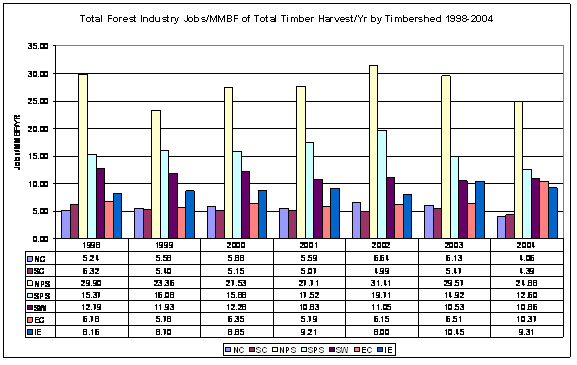
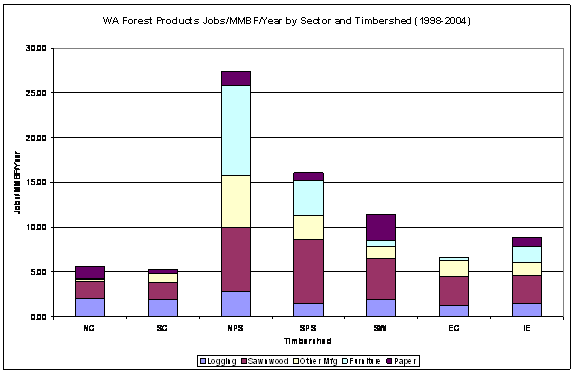
Note that the distribution of forest industry jobs is dominated by Puget Sound manufacturing with comparatively little secondary economic benefit shared with more rural timbersheds. As a result, in Figures 3 and 4, it can be seen that the North and South Puget Sound timbersheds have greater employment benefits per unit of harvested timber than other Washington areas.
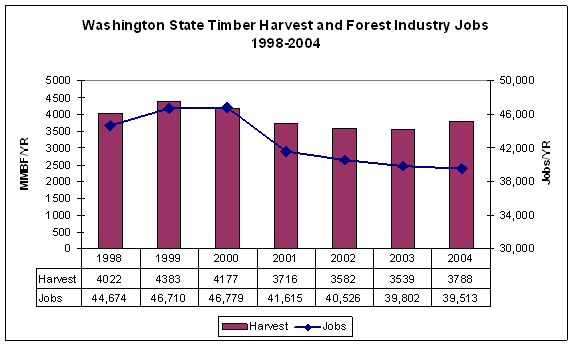 |
| Figure 1. Total Washington timber harvest and total forest industry jobs/year 1998-2004. |
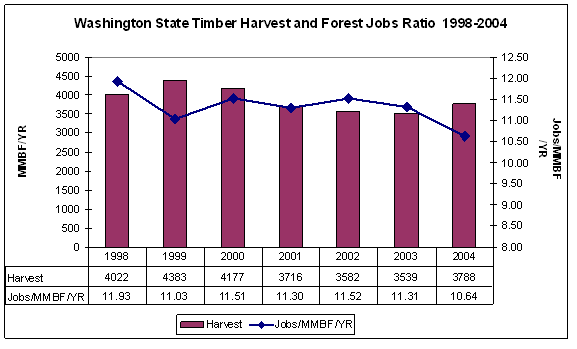 |
| Figure 2. Total Washington timber harvest and forest industry jobs/MMBF/year 1998-2004. |
| Table2a. Average annual employment by sector and totals (1998-2004) per MMBF/YR for each timbershed. |
| Sector | Jobs/MMBF/YR by Timbershed |
||||||
| NC | SC | NPS | SPS | SW | EC | IE | |
| Logging | 2.01 | 1.88 | 2.77 | 1.44 | 1.93 | 1.29 | 1.45 |
| Sawnwood | 1.89 | 1.93 | 7.19 | 7.21 | 4.59 | 3.16 | 3.15 |
| Other MFG | 0.24 | 1.02 | 5.77 | 2.63 | 1.28 | 1.8 | 1.47 |
| Furniture | 0.17 | 0.03 | 10.1 | 3.9 | 0.7 | 0.35 | 1.8 |
| Paper | 1.32 | 0.47 | 1.58 | 0.9 | 2.95 | 0.01 | 0.98 |
| Total | 5.63 | 5.32 | 27.42 | 16.08 | 11.47 | 6.62 | 8.85 |
| Table 2b. Average annual employment by sector and totals (1998-2004) per MMBF/YR for state region and the state. |
| Sector | Jobs/MMBF/YR by Region and State | ||
| West | East | State | |
| Logging | 1.97 | 1.35 | 1.83 |
| Sawnwood | 4.47 | 3.12 | 4.1 |
| Other MFG | 2.07 | 1.65 | 1.95 |
| Furniture | 2.55 | 1.05 | 2.14 |
| Paper | 1.54 | 0.47 | 1.25 |
| Total | 12.59 | 7.64 | 11.28 |
 |
|
Figure 3. Average forest industry Jobs/MMBF/YR timber harvest by timbershed 1998-2004. |
 |
|
Figure 4. Average forest industry Jobs/MMBF/YR timber harvest by sector and by timbershed (1998-2004). |
Estimated average industry jobs/MMBF/YR of timber harvest (1998-2004) were introduced as input variables to the Washington Input-Output Model to create estimates of total downstream economic activities/MMBF/YR of timber harvest in 2004 dollars. An iterative routine was employed to segregate direct and indirect forest industry jobs from total forest jobs (the known input data derived from census information). Once direct forest industry jobs were determined, indirect non-forest jobs estimates can be calculated by the model along with labor income, gross state product, and state and local taxes.
Economic impacts as previously estimated
The basic sector outputs from the model used for economic impact assessments in the prior studies are provided in Table 3. The model provides direct and total employment, direct output, gross product and state & local taxes for logging and sawnwood, as two components of primary wood; secondary wood, primary paper, and a total forest sector impact. Employment and economic outputs are presented as estimates of job-years and millions of 1992 dollars for one million board feet of annual timber harvest in Washington State (MMBF/YR).
| Table 3. Employment, Economic Output, and Tax impacts generated by one million board feet of annual timber production in Washington State (employment in-person years, output in millions of 1992 dollars adapted from WPSM 1994). |
 |
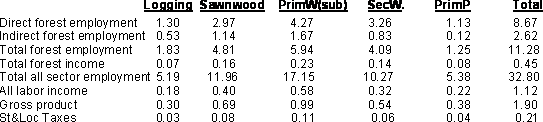
For more current estimates of economic activity, we update the employment data to 2004 based upon current employment averages used with the state input-output model as described above. Results are shown in Table 4 below. Prior and current results are presented for comparison; however, the WSPM data (1992) originated with SIC employment classifications while the updated data (1998-2004) is from NAICS. Data source differences create some sector inconsistencies for direct comparisons. It should also be noted that, in the prior study, indirect forest industry employment was reported as part of total employment, while, in the updated analysis, indirect forest sector employment has been isolated for addition to direct forest jobs to generate an estimate of total forest industry employment comparable to employment census publications.
Logging sector direct employment shows slightly higher labor intensity in 2004 than in 1992 which is consistent with harvest of more difficult locations and smaller diameter timber. The NAICS logging classification also captures some forestry activities such as timber tract operations, reforestation, and gathering of non-timber forest products. Sawnwood, however, shows a decline in employment per unit input indicating productivity gains by fewer but much larger and efficient sawmills than in prior studies. Secondary wood processing is split out into two categories, other manufacturing (such as molding, millwork, doors, and windows) and wooden furniture manufacture, picking up some value-add manufacturing activity either not present in 1992 or not included in earlier models. Primary paper direct employment per unit input is very close to the prior assessment indicating that, while gross levels of activity in this sector may have declined and per-unit-outputs may have increased, the per-unit-input productivity has remained relatively constant. The 2004 table is expanded to show the impact detail of the subset of indirect jobs within the forest sector i.e. some parts of the forest sector outsource to other parts of the sector and appear as within-sector transactions as mentioned above. This approach allows a direct comparison to the sector by sector jobs picked up in our surveys, which include both the direct employment and other within-sector employment comprising a Total Forest Industry Employment estimated as job-years/MMBF/YR for logging and other forest industry sectors. This presentation of direct and indirect forest sector detail is intended to resolve confusion that, in the past, arose when direct job estimates (from input-output analysis) were compared against data from business-reported employment roles and were found not in agreement.
The Total Washington Direct Forest Industry employment appears higher than in prior studies with some gains explained by increased productivity as evidenced by record lumber production. Increased jobs/MMBF/YR of timber harvest can also be explained by inclusion of two secondary manufacturing sectors as mentioned above and detailed in the Appendix. The differences in sector results are also, in part, a relic of data inconsistencies between SIC and NAICS classifications, however, differences in sector classifications should largely disappear in summary comparisons of total industry employment. Labor Income is computed from employment using average labor rates within the Input-Output Model (I-O) adjusted to reflect 2004 dollars. Total Employment is estimated in the model including inter-industry transactions and indirect purchases and services for a direct plus indirect job estimate in support of the Forest Sector economic activity (multiplier). Gross State Product (GSP) and State and Local Taxes are computed based upon ratios to Labor Income for 2004. State & Local taxes are estimated directly from the statewide economic activity and do not reflect extra taxes leveled on the industry such as the timber excise tax or additional revenue streams to counties such as Payments in Lieu of Taxes (PILTS) from the federal government. Comparison of summary results from 1992 and 2004 shows increased forest industry employment per unit input attributable to reasons suggested above. Decreases in the total direct and indirect employment multiplier result in part from the previously-discussed differences between the dynamic (WPSM) verses static (I-O) models. However, the decline in total employment levels is more directly related to the declining harvest with its diminished influence on the total state economy.
| Table 4. Employment, Economic Output, and Tax impacts generated by one million board feet of annual timber production in Washington State (employment in person-years, output in millions of 2004 dollars calibrated to the Washington State Input-Output Model NAICS). |
 |
It is important to note that not all activities generally perceived to be within the Forest Sector are actually defined as part of the Total Forest Industry in the economic models. For example, trucking is considered by the employment model as an indirect service provided by the Transportation Sector while some forestry support services, such as forestry consulting, firefighting, and pest control, are classified as Agriculture Sector activities. The employment benefits of these sectors are not unrecognized however, as many of these activities are captured as indirect employment in the Total Employment estimates generated by the Forest Sector activities.
Employment data adjustments were made to reflect estimated corrections for influences of log exports and chip imports on processed volumes but not foreign purchased port activities. For the five Westside timbersheds, while logging jobs were considered as necessarily associated with all harvested log volumes, processing sector estimates of jobs/MMBF/YR (Sawnwood, Secondary Manufacturing, and Paper Processing) were adjusted to reflect reductions, as created by log exports, to total harvest volume available for instate process. While the trucking jobs connected to log exports are likely captured by logging indirects, previous studies suggest that the magnitude of other export preparation activities, such as Stevedore jobs that are purchased by foreign consumers, are not captured as indirect activity in the Input-Output Model. It is assumed that there are no exported logs from the two Eastside timbersheds.
Employment from pulp and paper manufacture, as a consequence of state timber harvest volumes, is considered to be only fifty percent of total state paper employment since approximately one half of the state pulp and paper production is made from chip supplies imported from out-of-state suppliers or from recycled materials (Wolford pers. com.).
While some logs harvested in Washington are likely to be processed in neighboring states, the reverse is also true. Some volumes of logs from other states enter Washington for processing. The net impact from interstate log traffic is believed to be small and beyond the scope of this study. It is assumed, therefore, that for our economic estimates, log traffic for processing into- and out-of-state (excluding international log exports) has a neutral effect on employment. The distributional impacts associated with primary and intermediate product shipments between timbersheds, however, are captured by the actual census employment data by sector.
Total state economic impacts from annual timber harvest
Table 5, presented below, summarizes the average annual employment and revenue impacts from timber harvest in Washington from 1998 through 2004. Economic results are presented in millions of 2004 dollars. Total jobs and economic benefits for the logging sector have been calculated based upon an average annual harvest of 3.9 billion board feet. Processing jobs are based upon the total harvest net of log exports which averaged 660 million board feet per year. While the trucking jobs connected to log exports are likely captured by logging indirects, international export preparation acivities such as Stevedore jobs are not. Paper employment, as a consequence of timber harvest, is considered to be fifty percent of total state paper employment since approximately half of the state paper production is from chip supplies imported from out-of-state suppliers or from recycled material. Total direct and indirect employment was found to be 109,253 jobs with total labor income of $3.7 billion and an average annual wage of $34,000. Forest industry annual wages average $39,000 with a low for the furniture sector of $30,000 and a high for the paper industry of $60,000 (wage detail is provided in the Appendix). The average annual Gross State Product (GSP), which includes labor income, business taxes, and capital income, resulting from timber harvest was found to be $6.3 billion with State and Local Taxes associated with this activity level equal to around $713 million per year. The average annual Gross State Product for Washington from 1998-2004 was $226.1 billion. The activities introduced by the timber harvest contributed about 3% of GSP during that period.
| Table 5. Total Jobs and Outputs/Ave Total Harvest MMBF/YR 1998-2004 (see also Table 9) |
 |
Close examination of the total jobs and outputs/average total harvest with adjustments to manufacturing sectors to reflect the impacts of log exports (Table 5) shows a decrease in multipliers/MMBF of total harvest volume for the manufacturing sectors as compared to Table 4. These changes (presented in Table 6 below) are specific for the average total harvest verses exported timber volumes for the years 1998-2004. The authors recommend that use of the updated multipliers developed in this report should begin with figures as shown in Table 4. Totals are then calculated based upon the harvested and export volumes of interest as demonstrated in Table 5. Depending upon different total harvest to exported volume ratios, the multipliers for manufacturing sectors will self-adjust.
| Table 6. Adjusted manufacturing employment multipliers as a result of 1998-2004 average log exports. |
 |
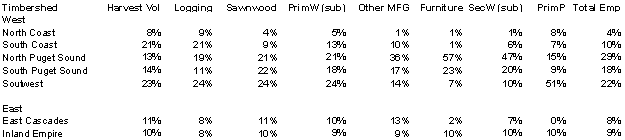
Table 7 shows a summarized distribution taken from this analysis of forest industry jobs by sector as a percentage of state totals for the Westside verses the Eastside of Washington. Comparisons of percentages by timbershed for harvest volumes and forest industry jobs are shown in Table 8. The west contributes 79% of the total state timber harvest volume but benefits from 83% of total forest industry employment. Note that five out of the seven timbersheds contribute a larger percentage share of state timber volume than comes back in relative employment benefit. The counties within these timbersheds are generally considered to be the more rural areas of the state. The more urban Puget Sound area, which has historically been the distribution and transportation center for Washington , accounts for only 27% of the timber harvest but benefits from 47% of the jobs. While forest industry employment and revenue streams may leverage higher as a contributor to less diverse rural economies, this analysis shows that almost half of the actual economic benefit occurs in more urban areas.
Table 7. Forest Industry Employment and Economic Impact West and East as a Percentage of State Totals by Sector |
 |
Table 8. Forest Industry Employment by Sector by Timbershed and Harvest Volumes by Timbershed as a Percentage of State Totals |
 |
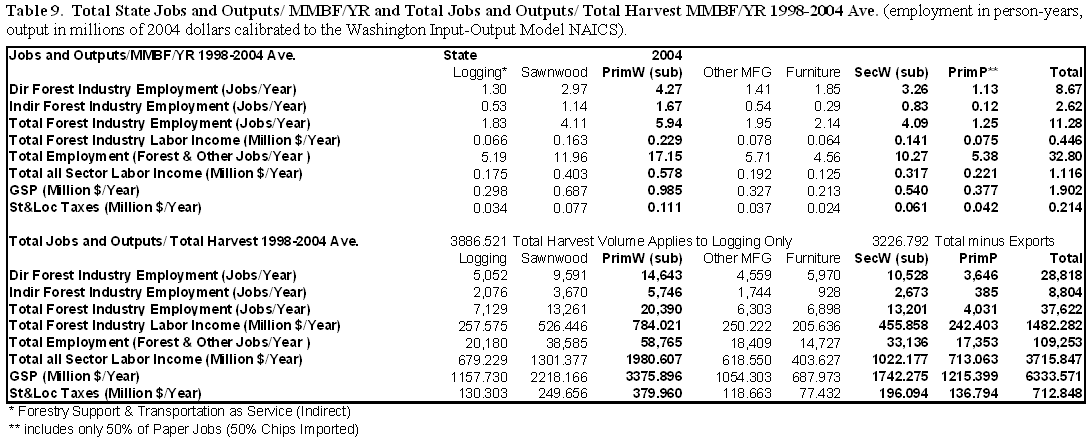
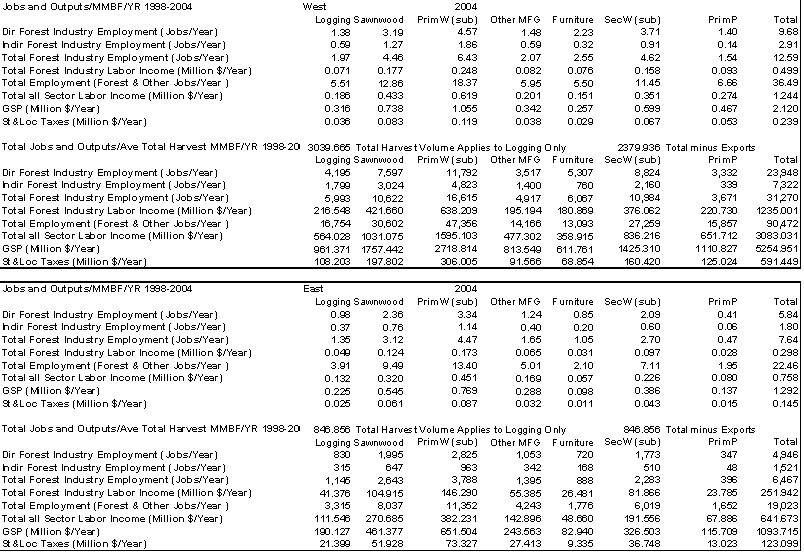
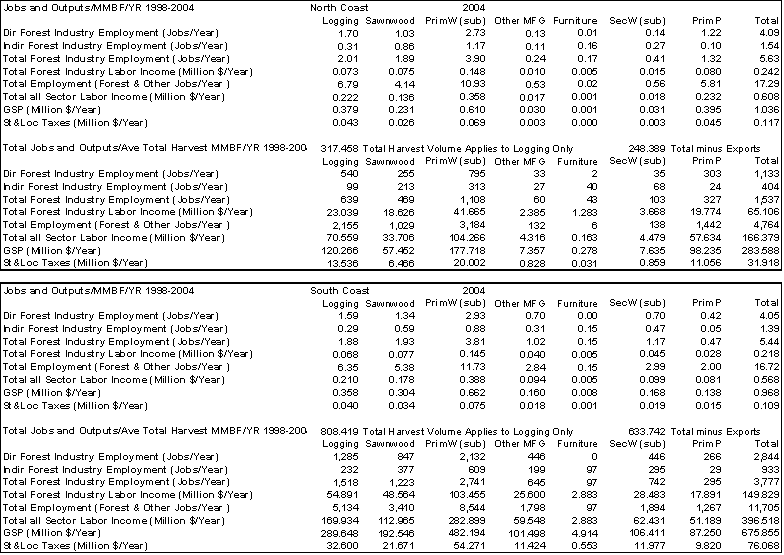
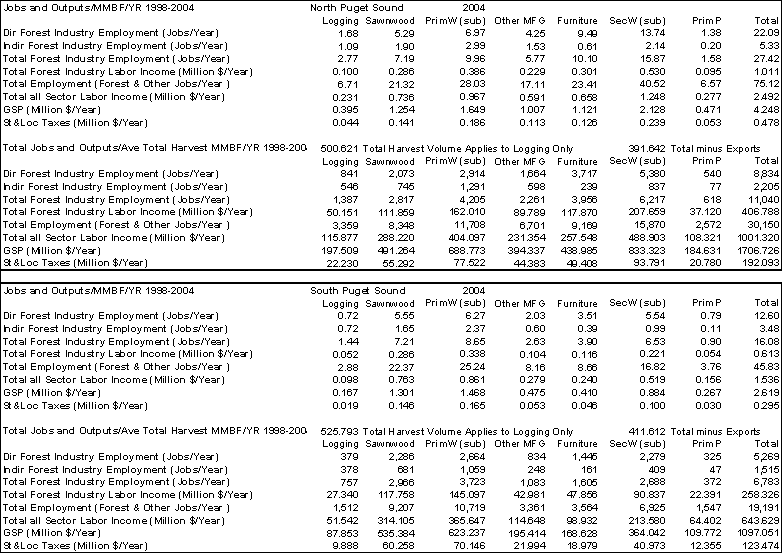
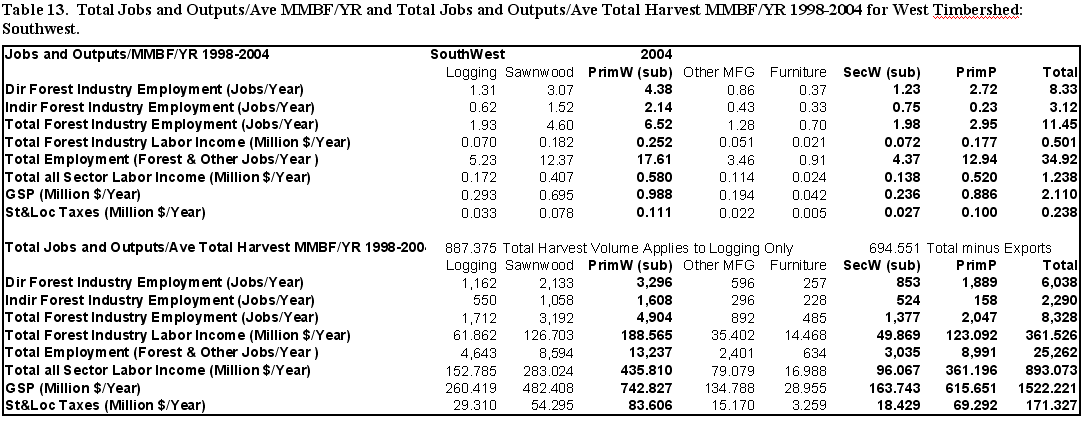
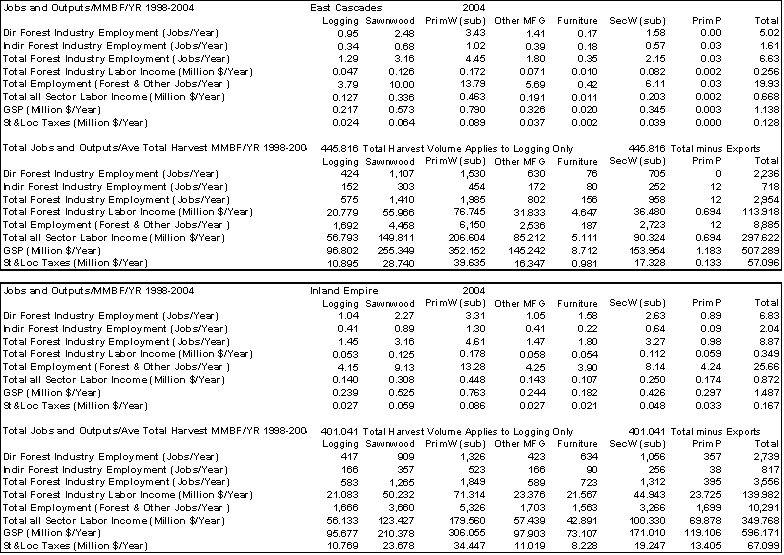
Detailed tables for the state, state regions, and by timbershed are given below. These analyses provide updated multipliers for employment, labor income, GSP, and state and taxes derived from one million board feet of timber harvest per year. Multipliers have been developed for use in analysis of timbersheds, state regions, and total state activities linked to timber harvest. An important application for forest industry multipliers is in investigation of comparative harvest scenario outcomes such that the marginal benefits of different business and policy choices can be better understood. The state, the regions and the timbersheds each have unique multipliers that are dependent upon sector employment and harvest. Table 9 shows state multipliers from which analysis in this report, unless otherwise specified as by region or timbershed, is based.
Table 9. Total State Jobs and Outputs/Ave MMBF/YR and Total Jobs and Outputs/Ave Total Harvest MMBF/YR 1998-2004.
Table 10. Total Jobs and Outputs/Ave MMBF/YR and Total Jobs and Outputs/Ave Total Harvest MMBF/YR 1998-2004 for Western Washington and Eastern Washington.
Table 11. Total Jobs and Outputs/Ave MMBF/YR and Total Jobs and Outputs/Ave Total Harvest MMBF/YR 1998-2004 for West Timbersheds: North Coast and South Coast.
Table 12. Total Jobs and Outputs/Ave MMBF/YR and Total Jobs and Outputs/Ave Total Harvest MMBF/YR 1998-2004 for West Timbersheds: North Puget Sound and South Puget Sound.
Table 13. Total Jobs and Outputs/Ave MMBF/YR and Total Jobs and Outputs/Ave Total Harvest MMBF/YR 1998-2004 for West Timbershed : Southwest.
Table 14. Total Jobs and Outputs/Ave MMBF/YR and Total Jobs and Outputs/Ave Total Harvest MMBF/YR 1998-2004 for East Timbersheds: East Cascades and Inland Empire.
Results - Impacts of Treatment Differences
While Table 4 presents updated estimates for current levels of timber industry productivity and state impact, further refinements can be developed to reflect the economic impacts of different management treatment alternatives that in turn can be linked to a timber and forest structure supply model. As noted in Lippke et al (1996) a first thinning treatment is much more labor intensive than a final regeneration harvest as a consequence of lower volume and smaller pieces, while a second and third treatment are just slightly more labor intensive then regeneration harvests. Similarly, thinnings with much smaller diameter trees are weighted more heavily to chips for pulp and paper and less heavily to secondary wood uses whereas longer rotations produce higher quality and increases in secondary manufacture.
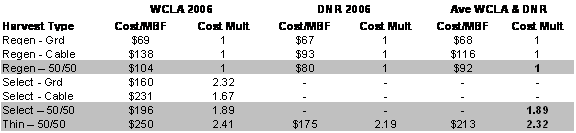
Estimates of alternative treatment employment impacts were developed from relative harvest cost comparisons provided by the Washington Department of Natural Resources and a survey of Washington Contract Loggers Association membership. For this demonstration, the average regeneration harvest cost per thousand board feet (MBF) of logs removed (Regen - 50/50 as an average with WCLA and DNR reporting) is assumed as a baseline and given the relative value of 1 (Table 15). Average selection harvest costs (Select - 50/50 with only WCLA reporting) were found to be 1.89 times more costly than the baseline regeneration harvests. Average commercial thinning costs (Thin - 50/50 as an average of with WCLA and DNR reporting) were found to be 2.32 times more costly than the baseline regeneration harvests. Long rotation harvests are assumed to have the same cost as the baseline (Regen - 50/50). Assuming that operational cost increases are accompanied by proportionate worker-hour increases, then the estimated cost increases can be used to adjust the economic multipliers in Table 4 to estimate comparative impacts of forest management alternatives on employment, revenues, and taxes.
Table 15. Washington comparative harvest costs by treatment type with cost multipliers developed with regeneration harvest cost as the baseline. |
 |
Impact of Treatment Differences
Different treatments produce different log outputs that serve different end uses. By noting how these treatment differences affect the sector level data in the model, a first-order estimate of the impact of different treatments can be obtained. Listed below are sample treatment alternatives typical of management options that vary by landowner type and objectives. For example, large private forestland owners, obligated to investment responsibilities, maximize economic returns through short commercial rotations whereas public forestland managers may favor longer rotations and thinning harvests to integrate financial return with habitat enhancements. Table 16 summarizes the sector impact responses for different westside treatments, as described below, relative to the average base case and Table 17 scales the treatment response to our normalized treatment size of one million bd. ft. harvest. Table 18 and 19 provide similar response tables for the eastside.
Treatment Alternatives
Base (Regen - 50/50): Regeneration harvest at 50 years after full plantation stocking followed by a pre-commercial thin (PCT) for density and quality control (the dominant historic treatment for Western Washington ).
First Thin (Thin - 50/50): Commercial thin at around age 30, roughly half by ground processor equipment (low slopes) and half by skyline (steep slopes) with costs almost twice the baseline.
Second Thin (Select - 50/50): Commercial thin at about age 50 with fewer small logs flowing to chips and more large logs for increased secondary manufacture.
Third Thin (Select 50/50): Commercial thin at about age 70 with more uniform and larger logs.
Long Rotation Harvest (Regen - 50/50): Regeneration final harvest of large mostly uniform trees producing more quality wood and secondary manufacture but less chips.
Sector Impacts
Logging (Prim W.): More costly thinnings with more jobs based on lower volume operations and handling of smaller diameter material.
Sawnwood (Prim W.): Sawnwood plus plywood with more quality volume from longer rotations.
Other MFG and Furniture (Sec W.): Half sensitive to higher quality wood (doors, windows, cut stock, mill work) but including pallets (low quality), trusses (above average structural quality), and furniture. Excludes building construction.
Primary Paper: Paper mills receive chip volumes primarily from mill processing residuals and smaller diameter logs.

Table 17. Adjusted employment impacts for different treatments for Western Washington . |
 |

Table 19. Adjusted employment impacts for different treatments for Eastern Washington. |
 |
Employment and Other Economic Outputs per unit of volume for different treatments
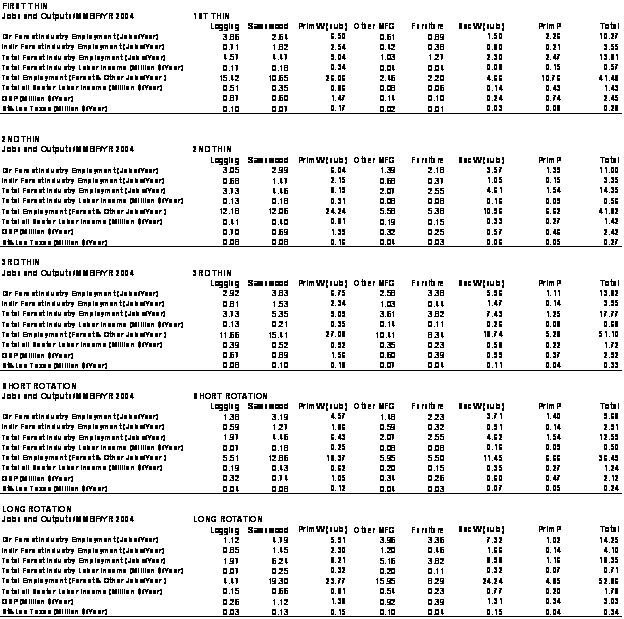
We have chosen not to include future productivity gains in the labor projections since it is easier to evaluate impacts on a current productivity or constant labor productivity basis. We prefer to display the impact of different treatments directly for demonstration rather than to confound the comparative treatment outcomes with unreliable estimates of productivity in the future. Labor income is generally the more stable measure of employment over a projection period as productivity gains are generally passed on to wage gains so the labor wages are not likely to be compromised by productivity changes over time. Comparative impact tables are provided below by treatment type for the Westside and Eastside (Tables 20 & 21).
 |
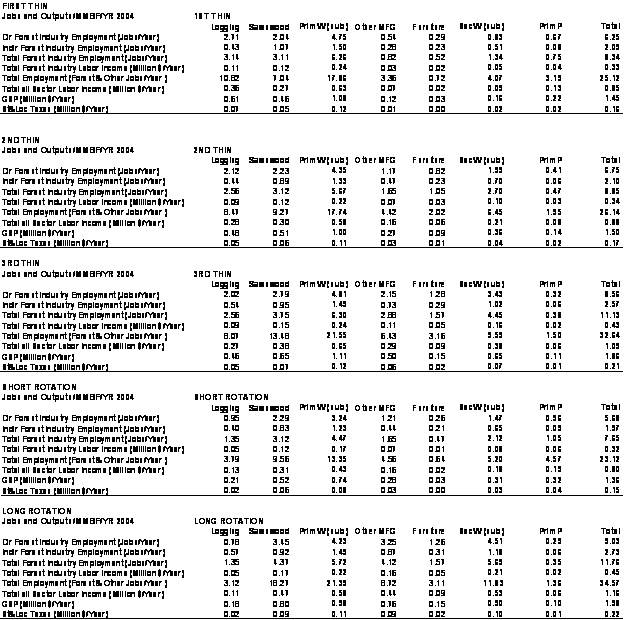 |
Economic impact estimators are provided above to characterize the comparative effects of different management treatments for both the Westside and Eastside that reflect regional infrastructure differences in harvesting and processing. In Western Washington , current industrial forestland management favors short rotation regeneration harvests for maximum economic return (base case) which provide 12.59 direct jobs/MMBF/YR while other private and public forestland owners are likely to include more thinning treatments that increase jobs benefits. Determining a base case scenario for the Eastside is somewhat more complicated as multiple cohort and repeated thinning harvests are more common than the single cohort management regimes of the Westside (Oliver et al. 1994). However, the significance of the lower job multipliers on the Eastside should not go unnoticed as compared to the Westside. Lower multipliers combined with much smaller harvest volumes on the Eastside result in Westside timber activities dominating the State Forest Sector contribution to the state economy. However, emerging policy recognition of the need to reduce stocking densities within Inland West forests for dual benefits of forest fire hazard mitigation and utilization of biomass for renewable energy may generate future increases in forest management activities and employment for Eastern Washington (DNR 2004a, 2004b, The White House 2003).
While the long rotation treatment alternative increases the jobs per unit of removals by as much as 45% it should be noted that jobs benefits occur very far in the future and may be subject to unforeseeable changes including productivity gains and policy changes prior to the activity. Thinning treatments, such as the first thin, increase the job impact a modest 10% since added logging labor is largely offset by secondary (value-add manufacturing) labor declines, however, unlike the long rotation, the impact is near-term and can increase economic activity early in the rotation period. Since different management treatments are practiced in different timbersheds with different infrastructure and employment bases, we can logically expect somewhat different job impacts in each local region. Tables presented above for West verses East have been developed to demonstrate such differences. Future research to investigate marginal trade-offs in forest landowner net present value returns from alternative management approaches as compared to potential increases in state employment and tax revenues could provide useful cost/benefit analysis to inform forest policy in regards to the public benefits that could arise from management incentive programs coupled with markets for environmental services such as carbon sequestration or habitat.
Case Study Example - North Coast Timbershed
The Washington Department of Natural Resources (DNR) is developing a forest land plan which will produce a set of forest management strategies for the Olympic Experimental State Forest (OESF). Much of the OESF is located on the northern Olympic Peninsula within the boundaries of the North Coast timbershed. DNR harvests are uniquely important to the economy of the North Coast as they represent close to thirty percent of the total annual harvest for all ownerships. The DNR percentage contribution to total state harvest volume is closer to eleven percent. The North Coast economy also has strong historic links to the forest industry and has experienced economic disruptions from reduced public harvest activities. North Coast counties are trust beneficiaries that own significant forestlands and rely upon timber revenues from the OESF to support community services.
The final post-settlement and adjusted Sustainable Harvest Calculations for the next decade were recently summarized in the Future of Washington's Forests and Forest Industries Report (College of Forest Resources 2007, Brodie 2007). Harvest activities include a combination of thinning and extended rotation regeneration harvests that have been designed to integrate habitat enhancements with revenue generation. Increased thinnings represent a departure from the trend in commercial management with the objective of enhancing habitat. To demonstrate the comparative employment differences to local economies of treatment alternatives, as estimated by the economic impact model developed for this report, we offer assessment below of DNR-proposed harvest activities for OESF lands within the North Coast timbershed along with a baseline alternative for which the same volume is removed by regeneration harvest only (Tables 22-24b). Since our interest is in employment comparisons and associated economic impacts, stumpage revenues and environmental outcomes are not estimated for this demonstration but would be important for understanding marginal trade-offs as part of a complete forest planning analysis
Table 22. Annual harvest yields in million board feet by treatment type and management regime for the forestlands within the OESF on the North Coast of the Olympic Peninsula. |
 |
Table 23a. Total Jobs and Outputs/Ave MMBF/YR - DNR Integrated Management |
 |
Table 23b. Total Jobs and Outputs/Ave MMBF/YR - Regeneration Harvest Only |
 |
Table 24a. Total Jobs and Outputs/ 94.687MMBF/YR - DNR Integrated Management |
 |
Table 24b. Total Jobs and Outputs/ 94.687 MMBF/YR - Regeneration Harvest Only |
 |
Harvest yields of 95 MMBF/YR are held constant for both management regimes. To approximate results of proposed DNR management, 19% of the volume is removed by thinning and 81% of the volume is removed by regeneration harvests. The baseline simulation removes all volume by regeneration harvest. Employment estimates are derived from treatment-specific multipliers presented in previous pages of this report. The DNR integration of thinning into the harvest regime for the OESF results in additional employment and associated economic benefits as compared to the regeneration-harvest-only baseline. Forest industry jobs are increased by 46. The total of all direct and indirect jobs is increased by 140. Gross state product, as related to employment activity, is increased by $8.066 million and state and local taxes are increased $908,000.
The approximately 8% increase in economic activity is a direct result of the additional thinning treatments, a more active management option to enhance habitat that requires more labor earlier in the rotation thereby resulting in increased economic activity and output. To the degree that DNR mixed treatments result in equivalent volume production to the baseline but with a higher quality log mix over a rotation, trust revenues might also increase contributing additional benefits. However, a complete analysis of impacts would require an investigation of the impact of deferring some of the harvest for longer rotations which could reduce trust revenue, net present value, and regional employment. A much more detailed analysis will be needed to characterize all of the economic impacts, environmental benefits, and tradeoffs. The availability of economic impact tables makes it possible to more fully analyze complex sets of management alternatives.
Results - Increased benefits from timber revenues reinvested in the state economy
Returns from state timber sales to trust beneficiaries
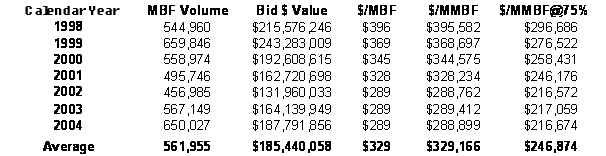
Estimated employment and revenue figures from timber harvest in Washington State , as presented above in Table 5, reflect direct and indirect economic activity resulting from timber harvest but do not reflect all additional benefits that accrue from re-investment of timber revenues in the state economy. Timber revenues are largely accumulated dividends that have been deferred since the initial investment in regenerating the forest. Dividends are either paid back to shareholders or reinvested. While levels of re-investment from the private sector logically may flow as shareholder dividends to other regions depending upon the attractiveness of the instate re-investment and will fluctuate over time depending upon markets, policy changes, and other factors, this is not the case for the Washington Department of Natural Resources (DNR). Stumpage revenue generated from DNR timber sales has a uniquely powerful impact on state wealth as it is reinvested within the state; approximately 75% of stumpage revenues are reinvested for the public good (as returns to trust beneficiaries) in government projects and services in Washington . Trust beneficiaries include K-12 public schools, state universities, other state institutions, and local services in many counties. The remaining 25% funds DNR operations providing direct employment to the 200 forestry professionals and administrative personnel charged with the sustainable management of state forests many of which are located in rural counties. There are two ways to think about assessing the impacts of the returns to trust beneficiaries. First, if trust revenue that funds school construction and government operations is reduced then, as activities slow, jobs, in these sectors as well as those impacted indirectly, are lost. Second, if taxes for Washington residents are raised to replace trust revenue shortfalls then job losses result from subsequent reductions in disposable income. An estimate of the added benefits provided by DNR stumpage revenues was calculated based upon the latter assumption; DNR revenues provide public services that otherwise would require tax increases therefore these revenues function as additional state labor income. The average annual timber volume harvested from state forests for the years 1998 through 2004 was 562 million board feet. The average stumpage return was $329/MBF (DNR 2007). Total average annual revenue exceeded $185 million with 75% returned to the trust beneficiaries and the state economy equal to $134 million per year. To model the impact of the addition to the state economy from returns to trust beneficiaries, we added an additional labor income benefit of $246,874 per million board feet of harvested timber to state baseline multipliers as presented in Table 4 and calculated the cumulative impact based upon an average annual DNR timber removal from 1998-2004 of 562 MMBF(Table 25).
Table 25. Volume and value of DNR timber removed 1998-2004 with approximated average return to trust beneficiaries per 1 million board foot of timber sold. |
 |
A comparison of the difference in state economic activity without and with re-investment of trust revenues generated from a harvest volume of 562 MMBF is shown below in Tables 26 and 27. Results are presented in 2004 dollars. Note that the total benefits of re-investment of trust returns in the state economy, as shown in Table 28, include 2,537 additional jobs with an increase to the gross state product of $365 million, which is almost double the value of DNR stumpage returns.
Table 26. Annual economic outputs from DNR timber sales without re-investment of trust revenues. |
 |
Table 27. Annual economic outputs from DNR timber sales with re-investment of trust revenues. |
 |
Table 28. Difference in annual economic outputs from DNR timber sales with re-investment of trust revenues. |
 |
Results - Survey Analysis
Logging
A comparison of modeled employment-to-harvest ratios with analysis of industry survey data shows close agreement. A survey of the Washington Contract Loggers Association (WCLA) returned 98 responses from companies that cumulatively harvest approximately one billion board feet of timber annually or about one-fourth of the total state production. Respondent companies provide about one-fifth of all state logging jobs. Analysis of response data indicates that these companies employ 1.42 loggers for every million board feet of timber that they harvest annually. This figure is slightly less than the total 1.83 loggers per MMBF as suggested by our modeling of the census data. This difference may be partly explained by the difference in portion of harvest verses portion of employment for respondent companies. A larger share of harvest than employment would indicate that respondents are above-average producers and that the job-to-harvest ratio would increase when all logging companies are included. A higher total result from census data analysis can also be expected since some forestry jobs are included in the NAICS employment classification.
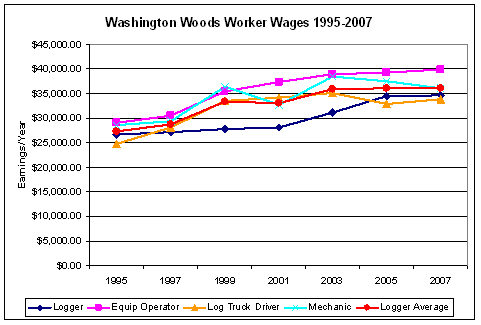
The average number of employees for respondent companies was 13 with two-thirds of companies operating on the Westside. Companies report that more than 80% of harvest activities occur on private forestlands and the average logging company has been in business for 25 years. Our modeled analysis indicates an average logging wage of $36,131 per year. Survey respondents report an average wage of $18.07 per hour. Coincidentally, when this hourly wage is extended to an annual wage based upon 50 weeks per year and 40 hours per week, the resulting average annual wage is within one dollar of our estimate. However, our calculation is in 2004 dollars whereas respondent information is for 2007. If the model estimate is updated to 2007 at the rate of inflation, a logger should receive $39,841 in annual wages. An estimate of 2004 Washington logger income taken from historical data provided by WCLA is $35,976 (still very close to the model estimate). The Washington Employment Security Department reports that, in 2004, the average annual logging wage was $41,573. Either this state estimate is high or this annual wage reflects addition of overtime which is not uncommon for state logging jobs. However, occupational earnings comparisons should be made net of overtime benefits such that time-at-work is held constant. Wage data from the current and past logger surveys is presented by job type and as an average in Figure 5 (wages are not inflation-adjusted). While the average logger wage has increased since 1995, earnings have not kept pace with inflation and wages for mechanics and truck drivers have actually declined. The Washington Department of Employment Security reports that the average annual wage for all Washington workers in 2004 was $39,038, indicating that loggers receive wages below the state average.
 |
|
Figure 5. Woods Worker Wages (1995-2007) |
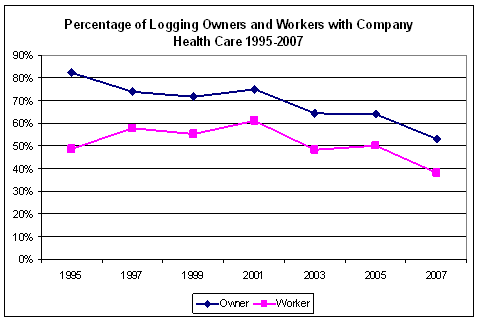
WCLA survey data provides addition insight into the health of the logging industry that can not be developed through modeled employment analysis. Health care is an important employment benefit, provision of which can be considered an indicator of business prosperity. Declines in health care provision since 1995 for the logging industry are shown in Figure 6.
 |
|
Figure 6. Health care benefits provided by Washington logging companies. |
In 2007, only 53% of company owners and 38% of company workers received company-provided health care benefits; down from 82% of owners and 49% of workers in 1995. In comparison, Employment Security reports that 62% of all Washington workers received health care benefits in 2005. For all Washington companies of similar employment size as respondent logging companies (10-25), Employment Security reports that 75% of employees received health care benefits in 2005.
When asked how difficult it is to keep a crew of skilled workers, 95% responded that it is either occasionally difficult or very difficult with 46% indicating that it is very difficult to keep skilled workers. When asked to characterize current availability of skilled workers, 86% reported that skilled workers are more scarce today than was the case ten years ago. When asked if their companies were making money, loosing money, or breaking even, 87% of respondents indicated that their companies were breaking even or loosing money with 40% reporting financial losses from their business operations. A comparison of current harvest fees as estimated averages from WCLA and DNR data with a 1996 estimate prepared by Lippke et al. shows that loggers receive less today for harvest operations than they received 11 years ago.
Table 29. Washington Comparative Harvest Costs 2007 & 1996 in $/MBFHarvest Type |
WCLA/DNR Ave 2007 |
Lippke et al. 1996 |
Difference |
| Regeneration | $92 |
$150 |
($58) |
| Thin | $213 |
$275 |
($62) |
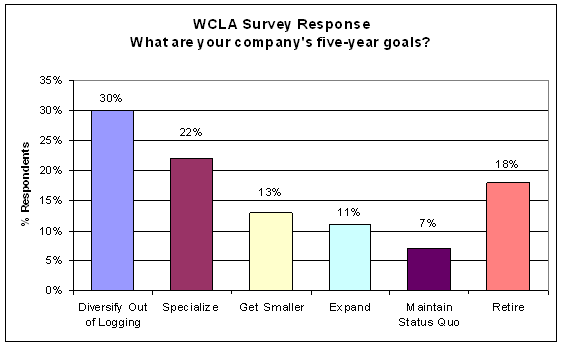
More than 60% of logging company owners report that they are over 60 years old. When asked about their company's five-year goals, 48% of logging companies surveyed reported that they expected to leave logging or retire (Figure 7). Logging survey response analysis when coupled with historic harvest fee comparisons indicates an uncertain future for this industrial sector.
 |
|
Figure 7. Logging company future goals |
Milling - Sawnwood
In recent years the volume of timber harvest in Washington has declined to historic lows and many forest products workers have lost their jobs but the total volume of lumber produced has steadily increased; setting a production record in 2006 of six billion board feet (Eastin et al. 2007). There are several reasons why this happened. Regulatory and market changes resulted in reduced log exports making more logs from state and private forests available to domestic processors (see Appendix). Mills that retooled for efficient utilization of smaller diameter logs experienced higher production and improved log-to-lumber recovery ratios through reduced saw kerf, curve sawing innovations, and other manufacturing modernizations. An overall gain in capacity was achieved as surviving sawmills made capital investments in production improvements (Spelter 2002). In 2003, sawmills producing more than 100 MMBF per year accounted for more than 64% of regional sawmill production, whereas in 1988, mills with such large capacity accounted for only 38% of total production (Western Wood Products Association 2004). During the period from 1994-2005, the average number of workers per sawmill increased from 36 to 67 and the average mill production increased from 18 MMBF/YR to 45 MMBF/YR. Lumber production per employee increased from 500 MBF/YR to 670 MBF/YR (Eastin et al. 2007).
In order to better understand transitions within the sawmill sector a mail survey of Washington milling companies was undertaken. A total of 70 operations were identified comprised of 45 Westside softwood mills, 14 Eastside softwood mills, and 11 hardwood mills. A total of 36 responses were received of which 34 were usable for analysis (7-East, 27-West). These mills represented an annual lumber production of 4.1 BBFT/YR, about 72% of the state total. The average surveyed sawmill processes about 60 MMBF/YR of logs, produces about 116 MMBF of lumber, and employs 128 workers. The largest mill employed 403 workers. For every MMBF/YR of logs input, survey responses indicate employment of 2.14 mill workers. This ratio is significantly lower than our modeled output of 4.11 jobs/MMBF/YR, however, survey respondents disproportionately represented the largest and most efficient operations. Also the Sawnwood employment classification used for the input-output analysis includes veneer, plywood, engineered wood products, and wood preservation. When these processing industries are removed from Sawnwood, the sawmill subset results in an estimate of 2.64 jobs/MMBF/YR. Industrial forestlands provide the major share of logs for sawmills in this state with other important log sources from non-industrial private, tribal, and state ownerships. Federal timber is generally unavailable (< 2% of supply).
Indicative of the interdependence within the forest industry, when sawmills were asked if they use company loggers or contract loggers to harvest timber, 72% responded that they used contract loggers. When asked a similar question about log transport, respondents indicated that 87% of their logs are hauled by independent truckers.
Overrun is the mill ratio of input log scale to the output lumber scale. Comparison of overrun calculated for respondent Eastside mills and respondent Westside mills provides interesting insight to regional sawmill competitiveness. Investments in modernization in Westside mills have resulted in gains in overrun yields whereas this has not been the case for the Eastside mills (Figure 8). Not coincidentally, while losses of Westside mill infrastructure have stabilized and production increased this has not been the case for Eastside sawmills where closures and infrastructure decline remain chronic (three Eastside mills closed in 2006). The large number of mills in Idaho just across the border further raise the question of viability for Eastern Washington sawmills. Perez-Garcia et al. (2007) found that Idaho is a much lower cost lumber producer than Washington , can compete favorably for the same log supply and the same product markets. While the situation appears better for Westside mills, Perez-Garcia et al. (2007), in an examination of the most significant competitors for the domestic lumber markets that Washington mills supply, found that the U.S. South log costs are 44% of Washington costs and that log costs in British Columbia are 30% of Washington costs.
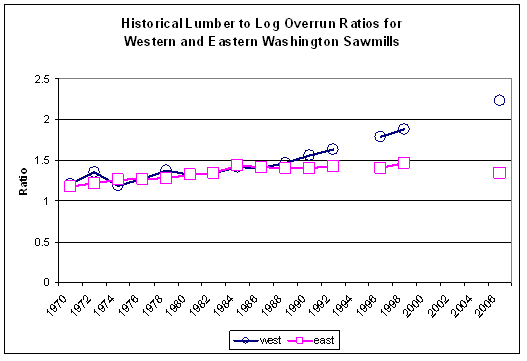 |
|
Figure 8. Lumber to Log Overrun for Western and Eastern Washington Sawmills. |
The contemporary sawmill industry in Washington has become increasingly homogenous in its raw material type, lumber production, and marketing. Most Washington mills consume softwood logs that average approximately 11 inches in diameter (minimum 6 inches and maximum 24 inches). Nearly 85% of production is dimension lumber, studs, or boards with 96% sold to domestic markets (30% instate and 66% to other U.S. states). This means that there is little product differentiation relative to competition from other states and countries. This also means that profitability for most mills in Washington is highly dependent upon fluctuations in U.S. housing markets. A notable exception is hardwood lumber production which serves export markets and secondary manufacturers.
Survey respondents report an average hourly wage for mill workers for 2006 of $19.85/hour. When this hourly wage is extended to an annual wage based upon 50 weeks per year and 40 hours per week, the resulting average annual wage is $39,695. The model estimated annual wage for mill workers at $39,700 in 2004 dollars ($43,777 inflation adjusted to 2007) indicating that, like loggers, actual mill wages do not appear to be keeping up with inflation. Sawmill companies were asked how difficult it is to keep or recruit qualified operations workers (filers, sawyers, and other positions unique to the milling industry) and trades personnel (millwrights, electricians, and other positions not unique to the sawmill industry). Table 30 displays survey response distribution.
Table 30. Availability of skilled mill workersVery Difficult |
Somewhat difficult |
Workers are available |
|
| Operations Workers | 31% |
59% |
9% |
| Trades Workers | 63% |
31% |
6% |
While more than 90% of respondents indicate that all skilled workers are difficult to keep and recruit, it is noteworthy that trades workers with skills transferable to other industries are especially difficult to keep and recruit. Survey respondents were also asked to characterize the availability of workers as compared to ten years ago; 75% responded that skilled workers are more scarce today. This response data, as with that of loggers, is indicative of a growing shortage of skilled workers available for employment in the forest industry.
Table 31. Summary statistics for Washington sawmills, 1981- 2005 (WWPA Yearbook various years).| Year | Production (BF/YR) |
No. Sawmills |
Employ- ment |
Production (BF/Mill) |
Employment/ Mill |
Production (BF/Employee) |
| 1981 | 3,200,000,000 |
240 |
10,083 |
13,333,333 |
42 |
317,354 |
| 1982 | 3,059,000,000 |
236 |
8,928 |
12,961,864 |
38 |
342,630 |
| 1983 | 3,821,000,000 |
233 |
9,346 |
16,399,142 |
40 |
408,837 |
| 1984 | 3,697,000,000 |
243 |
9,122 |
15,213,992 |
38 |
405,290 |
| 1985 | 3,419,000,000 |
235 |
8,268 |
14,548,936 |
35 |
413,512 |
| 1986 | 4,132,000,000 |
245 |
8,352 |
16,865,306 |
34 |
494,707 |
| 1987 | 4,645,000,000 |
260 |
9,059 |
17,865,385 |
35 |
512,758 |
| 1988 | 4,408,000,000 |
271 |
9,604 |
16,265,683 |
35 |
458,969 |
| 1989 | 4,024,000,000 |
251 |
9,651 |
16,031,873 |
38 |
416,961 |
| 1990 | 3,678,000,000 |
241 |
9,356 |
15,261,411 |
39 |
393,117 |
| 1991 | 3,581,000,000 |
217 |
8,152 |
16,502,304 |
38 |
439,279 |
| 1992 | 3,794,000,000 |
220 |
8,006 |
17,245,455 |
36 |
473,895 |
| 1993 | 3,555,000,000 |
215 |
7,451 |
16,534,884 |
35 |
477,117 |
| 1994 | 3,876,000,000 |
217 |
7,721 |
17,861,751 |
36 |
502,008 |
| 1995 | 3,764,000,000 |
211 |
8,109 |
17,838,863 |
38 |
464,176 |
| 1996 | 3,596,000,000 |
192 |
8,061 |
18,729,167 |
42 |
446,098 |
| 1997 | 3,851,000,000 |
193 |
8,612 |
19,953,368 |
45 |
447,167 |
| 1998 | 3,913,000,000 |
190 |
8,718 |
20,594,737 |
46 |
448,841 |
| 1999 | 4,224,000,000 |
181 |
8,403 |
23,337,017 |
46 |
502,678 |
| 2000 | 4,384,000,000 |
181 |
9,206 |
24,220,994 |
51 |
476,211 |
| 2001 | 4,257,000,000 |
159 |
7,515 |
26,773,585 |
47 |
566,467 |
| 2002 | 4,625,000,000 |
135 |
7,446 |
34,259,259 |
55 |
621,139 |
| 2003 | 4,898,000,000 |
130 |
7,519 |
37,676,923 |
58 |
651,416 |
| 2004 | 5,455,000,000 |
125 |
7,613 |
43,640,000 |
61 |
716,538 |
| 2005 | 5,729,000,000 |
128 |
8,565 |
44,757,813 |
67 |
668,885 |
The average sawmill in Western Washington has been in business for 53 years while the average Eastern Washington sawmill has been in business for 35 years. In contrast to loggers, 59% of sawmill survey respondents indicated that their companies are considering expansion of operations within the next five years.
Pulp and Paper Products
In recent years, the pulp and paper industry has experienced reductions in the number of operating mills in Washington and declines in production capacity. In 1988, there were 26 pulp and paper mills operating in Washington . By 2003, the number of operating pulp and paper mills was reduced to 15 accompanied by a 45% reduction in domestic production and a 71% reduction in exports (Figure 9). By 2006, the number of pulp and paper mills had dropped to 13 of which three rely almost exclusively on recycled fiber for their raw material. Most remaining capacity is located in Western Washington . There are presently 3 pulp and paper mills operating in Eastern Washington . Problems for this sector are not unique to the Pacific Northwest . Flat product prices, strong international competition, and high production costs have resulted in cuts in capital spending for the pulp and paper industry throughout the United States that in recent years have fallen below the point required to maintain facility competitiveness (Kinstrey 2004). Kraft pulping is the dominant pulping technology used in the United States and worldwide. However, kraft pulping is extremely capital-intensive. Newly constructed mills cost in excess of $1 billion and must process between 1,000 - 2,000 tons of dry wood chips per day to be economically viable (Youngquist and Hamilton 1999). No investments in new capacity for Washington are anticipated and future closures of existing facilities may occur (Lockwood-Post's Directory 2003).
The pulp and paper industry is an important Washington employer that provides the highest paying jobs in the forest industry. A survey of Washington 's pulp and paper industry returned 5 out of 13 questionnaires mailed. Respondents included four Westside mills and one Eastside mill. Cumulative production of respondents for 2006 equaled 150 thousand metric tons of pulp and 1.5 million metric tons of paper products.
Our modeled estimate of the average income for a paper worker is $60,135/year. Estimates for 2007 wages from industry are very close, $60,112/year. When our 2004 estimate is adjusted for inflation, the result is $66,311. An estimate of paper worker average wage developed from incomplete data supplied by Employment Security is $65,984/year with only paper and newsprint industries reporting. Unlike most of the other sectors of the forest industry, most paper mills operate under union contracts. Consequently, paper worker benefits, including health care, are assured. A majority of survey respondents, however, reported that both operations and trades workers were somewhat difficult to recruit with 60% reporting that skilled workers are more scarce today than was the case ten years ago. The average age of paper workers, based upon survey information, is 47 years. The average surveyed mill has been in business 54 years.
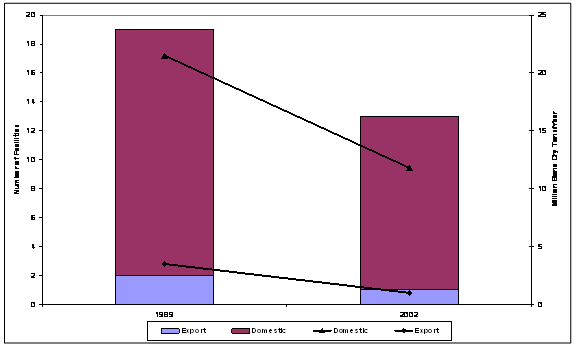 |
|
Figure 9. Number of WA Pulp Mills and Pulp Export Facilities & Total Annual Production 1989 - 2002. |
Survey respondents indicated that domestic markets receive most production; 16% to Washington , 78% to other U.S. states, and 6% to export. Respondent companies reported an average increase in productivity from 2000-2005 of 4.2%. In contrast to North American industry trends, 60% of companies report considering investment in production capacity within the next five years in spite of the fact that 60% of companies also rated the business environment in Washington as more difficult than that of out-of-state competitors.
In addition to its importance to the state economy; this sector is critically linked to the viability of the logging and sawmill industries. Pulp and paper companies are important consumers of low quality pulp logs as well as chips, sawdust, planer shavings and hog fuel produced by sawmills. For many sawmills the sale of manufacturing residuals to the paper industry is essential to profitability. In 2004, Washington sawmills sold 2.6 million bone dry tons of wood residues to the pulp and paper industry. Markets for pulp logs are also directly linked to forest management and forest health by providing utilization opportunity for small diameter timber and economic return to thinning operations. The pulp and paper industry purchases chips and hog fuel that are produced by Washington's 14 chipping operations which produce 1.7 million bone dry tons of chips annually (Smith and Hiserote, 2007). From a strategic perspective, it is essential to the future of Washington's forest industries that the pulp and paper sector remain viable.
With increased public interest in renewable energy, the future of the Washington pulp and paper is important beyond its contribution of jobs, revenues, and taxes. This industry is the largest single contributor of non-hydro renewable energy in the state and represents significant private investment in energy conversion infrastructure. Pulp and paper mills burn processing residuals in controlled combustion chambers to generate steam and clean electricity. It has been estimated that investments in increased recovery capacity could double energy yields from currently utilized feedstocks (Gustafson 2007). Addition of new energy generating capacity at pulp and paper mills could increase potential for biomass-to-energy conversion even more. Morris (1999) estimated that, for every megawatt of electricity generated from wood biomass, 4.9 jobs and $47,200 in tax revenues are created. Research into converting aging pulp and paper recovery boilers into biorefineries capable of producing liquid transportation fuels and valuable industrial chemicals from wood and other cellulosic feedstocks holds further promise for increased mill profitability, energy generation, and economic development (Larson et al. 2003, Agenda 2020 Technology Alliance and Energetics Inc. 2006).
The Washington pulp and paper sector, for purposes of this investigation, has been limited to NAICS classification code 3221 which includes pulp mills (NAICS 322110) paper mills other than newsprint (NAICS 322121), newsprint mills (NAICS 322122), and paper board mills (NAICS 322130). We refer to this sector as Primary Paper. Box plants and specialty converted paper manufacturers (NAICS 3222) have been excluded as secondary processors not sensitive to timber harvest. To assure that our employment analysis produced conservative estimate of pulp and paper employment sensitivity to state harvest volume fluctuations, we reduce employment tied to timber harvest based upon estimates that half of paper worker jobs result from imported chips and recycled paper. However, it could be argued that without Washington chips many pulp and paper businesses could not have adequate raw material to take advantage of imported chips and recycle paper. In addition continued availability of recovered paper may be in question as Washington exports have increased to meet a growing demand in China . In 2004, recovered waste paper represented around 10% of material inputs for pulp manufacture (Perez-Garcia 2007).
Conclusions
A model has been developed based upon the U.S. Census employment data used in the Washington Input-Output Model in order to update forest industry employment, revenue, and tax multipliers for use in analysis of the impacts associated with changing volumes and forest treatments characterizing the timber harvest for Washington State . Results are presented by timbershed, region, and for the state. Results have been shown to be consistent with survey response data from major sectors of the forest industry as well as state employment and earnings records, however, 2007 worker earnings for the sawmill and paper industries appear to be about ten percent below inflation-adjusted model estimates, evidence of severe competitive pressures. Applications of economic impact analysis have been demonstrated for different treatment alternatives. The unique contribution of state harvest revenues has been highlighted. It is the hope of the authors that this work will remain useful for cost-benefit and economic impact analysis of forest industry activities until such time as the Washington Input-Output model is again updated. We recommend that new analysis be undertaken when the I-O is updated so that forest industry multipliers are kept current with the latest information.
Economic impact estimates derived from linking forest treatments to processing can provide economic measures of importance to a local region that go beyond the analysis of sustainable economics for the individual landowner. While such economic activity depends upon sustainable forest management, sustainability is also sensitive to policy impacts that can affect management treatments by making either shorter or longer rotations more economically attractive. As demonstrated by the magnitude of economic contribution to the state economy from re-investment of trust returns, forest policy that encourages private sector investment in the Washington economy can have significant multiplier benefits. Private timber harvest and estimated returns are six times larger than from state managed lands.
The economic multipliers developed in this analysis are best current estimates grounded by surveys, census data, and engineering estimates of treatment differences as developed with the State Input-Output Model. The Forest Industry jobs estimate, alone, is not substantially different from estimates provided in earlier studies when adjusted for declines in harvest activities. Total direct and indirect jobs estimates derived from the Input-Output Model based on static interindustry relationships can be considered as conservative with lower total estimates than econometric projection models such as WSPM that are designed to more fully capture dynamic downstream indirect effects of re-investment, government services, and other activities.
To further assure that assessments of economic impacts sensitive to Washington 's timber harvest activities have not been inflated, model inputs have been adjusted as discussed above to reflect implications of log exports and chip imports. Not included considered in this analysis is the expectation that future gains in wood utilization such as biomass conversions for energy or greater manufacturing emphasis on engineered wood products will result in increases in job numbers per unit volume of harvest. A number of other economic activities are associated with the forest industry that, due to lack of data, have not been included in this analysis. For example, informal small businesses and casual labor, generally not documented by census data, such as non-timber forest products gathering and cedar salvage are not included in our economic estimators. Migrant and seasonal employment is not counted but may be significant and warrants further investigation. A study of migrant and seasonal labor estimated that approximately 1900 undocumented workers perform reforestation services in Washington each year (Larson, 2000). In Washington there are two universities and several technical colleges that offer research and educational programs in forest resource management and pulp and paper sciences. Personnel from these institutions, while not considered in this analysis, logically are engaged in economic activity that results from a significant forest industry presence in Washington . Family forest owners that tend to their lands while maintaining formal employment apart from the timber industry receive economic benefit from the harvest of timber resources, but are not considered in forest industry employment statistics. The Washington Input-Output Model produces employment estimates that are based upon state averages of inter-industry and intra-industry activities that do not differentiate between differing county economic circumstances and thereby may fail to capture the relatively high leverage of forest economies in rural areas. As an example, a study of forestry programs on tribal lands found that 51 direct and indirect jobs/MMBF of timber harvest/YR (more than 50% great than the State average estimated in this report) are provided from the unique economies generated by Indian forest management (Gordon et al. 2003). The economic assessments developed for this report clearly understate the economic contributions of forestry in Washington and should be regarded as conservative estimates. However, employment, revenue, and tax multipliers demonstrate the important industrial interrelationships associated with fluctuations in harvest volumes and will be useful to analysts for comparison of relative differences associated with forest management alternatives.
More research is needed to better understand the potentially diverse economic impacts of forest management to local economies. This information could help to inform policy response to many forestry issues of concern such as worker shortages, capital flight, land conversions, forest health declines, renewable energy development, and more. Further analysis could provide useful localized assessments of the unique contributions of re-invested DNR stumpage revenues for local economies and support of cost/benefit analysis for State forest planning. Analysis of direct and indirect economic impacts should be combined with estimates of non-market values and avoided costs resulting from forest management in order to broaden understanding of societal trade-offs associated with different outcomes for Washington's forests.
This project has been fortunate to benefit from the valuable information contributions of many forestry and economics professionals. The forest industry has struggled to meet the challenges that have emerged in recent years and appears to face significant obstacles in the future. Forest industry sectors have been shown to be mature and uniquely interdependent. Recognition of forest industry interrelationships will be important to guide future policy development. A viable forest industry will continue to be needed to sustain forest health and contribute to the state economy. Recent investigation indicates that the forest industry may also become increasingly important in Washington as a provider of biomass for conversion to clean renewable energy (Frear et al 2005).
References
Adair. C., 2004. Regional Production and Market Outlook. Structural panels and Engineered Wood Products 2004-2009. APA - The Engineered Wood Association. Tacoma , WA . http://www.apawood.org/
Agenda 2020 Technology Alliance and Energetics Inc. 2006. Forest Products Industry Technology Roadmap. American Forest and Paper Association. U.S. Department of Energy. 78pp.
Andrews, R.W. 1957. This Was Sawmilling. Superior Publishing Company. Seattle , WA . 176 pp.
Bergvall, J. and D. Gedney. 1970. Washington Mill Survey 1968. A jopint study by the Washington Department of Natural Resources and the Pacific Northwest Forest and Range Experiment Station. Olympia , WA .
Bergvall, J., L. Gee, anf K. Minneman. 1979. 1978 Washington Mill Survey. Division of Technical Services. Washington Department of Natural Resources. Olympia , WA .
Bourque, P.J., R.S. Conway, and C.T. Howard. 1977. The Washington Projection and Simulation Model: An Input-Output Econometric Model of Washington State . Graduate School of Business Administration , University of Washington Seattle , WA . 260 pp.
Bourque, P.J. and R.S. Conway. 1977. The 1972 Washington Input-Output Study. Graduate School of Business Administration , University of Washington Seattle , WA . 221 pp.
Brodie, A. 2007. pers. com. Dr. Brodie is the DNR Sustainable Harvest Project Manager. Olympia , WA .
College of Forest Resources. 2007. The Future of Washington's Forests and Forest Industries. Prepared for the Department of Natural Resources at the request of the Washington State Legislature. University of Washington . 320pp. plus appendices. http://www.ruraltech.org/projects/fwaf/final_report/index.asp
Conway, R.S. 1990. The Washington Projection and Simulation Model: A Regional Interindustry Econometric Model. International Regional Science Review. Vol. 13(1&2):pp. 141-165.
Conway, R.S. 1994. The Forest Products Economic Impact Study Current Conditions and Issues. Prepared for WFPA, WADNR, WADTED by Dick Conway and Associates, Seattle , WA . 40 pp. plus appendices
DNR. 2007. Office of Budget and Economics.
DNR. 2007. Economic Publications; Timber Harvest Reports http://www.dnr.wa.gov/htdocs/obe/surveysreports.html#harvest
DNR. 2004a. A Desirable Forest Health Program for Washington 's Forests. Forest Health Strategy Work Group Report.
DNR. 2004b. HCP Amendment No. 1. Administrative Amendment to the Northern Spotted Owl Conservation Strategy for the Klickitat HCP Planning Unit. Ellensburg , WA . www.dnr.wa.gov
Eastin, I., I. Ganguly, D. Sasatani, and B. Lippke. 2007. The Future of Washington's Forests Final Report; Study 3 Economic Contribution. University of Washington . Seattle , WA . pp. 157-237.
Frear, C., B. Zhao, G. Fu, M. Richardson, S. Chen, and M. Fuchs. 2005. Biomass Inventory and Bioenergy Assessment; An Evaluation of Organic Material Resources for Bioenergy Production in Washington State . Publication No. 05-07-047. Washington Department of Ecology and Washington State University . 120pp. http://www.ecy.wa.gov/pubs/0507047.pdf
Gordon et al. 2003. An Assessment of Indian Forests and Forest management in the United States . The Second Indian Forest management Assessment Team Report to the Intertribal Timber Council. Clear Water Printing. Portland , OR . 134pp.
Gustafson, R. 2007. pers. com. Dr. Gustafson is the Denman Professor of Pulp and Paper Science at the University of Washington . College of Forest Resources. Seattle , WA .
Haynes. R. (Tech. Coordinator), 2003. An Analysis of the Timber Situation in the United States : 1952-2050. Gen. Tech. Rep. PNW-GTR-560. Portland , OR : USDA Forest Service. Pacific Northwest Research Station.
Hewings, G.J.D. 1985. Regional Input-Output Analysis. Sage Publications. Beverly Hills , London , New Delhi . 95pp.
Isard, W. 1960. Methods of Regional Analysis: An Introduction to Regional Science. Technology Press of The Massachusetts Institute of Technology and John Wiley & Sons, Inc. New York & London . 784pp.
Kinstrey, R. 2004. Invest to Improve:P North America Struggles to Maintain its Global Cost Competitiveness. Pulp and Paper. Jan. 2004. www.paperloop.com
Larson, A.C. 2000. Migrant and Seasonal Farmworker Enumeration Profiles Study - Washington . Report prepared for the Migrant Health Program Bureau of Primary Care, Health Resources and Services Administration. 22pp.
Larsen, D. 2003, 2000, 1998, 1992. Washington Mill Surveys for 1998, 1996, 1992, 1988. Washington Department of Natural Resources. Olympia , WA . http://www.dnr.gov/
Larson,E.D., S. Consonni, and R.E. Katofsky. 2003. A cost-Benefit Analysis of Biomass Gasification Power Generation in the Pulp and Paper Industry. Navigant Consulting. Princeton University . Politecnico di Milano. 191pp.
Leontief, W.W. 1936. Quantitative Input and Output Relations in the Economic Systems of the United States . The Review of Economic Statistics, Vol. 18, No. 3. (Aug., 1936), p.105-125.
Leontief, W.W. 1966. Input-Output Economics. Oxford University Press. New York . 257pp.
Lippke, B.R. and R.S. Conway. 1994. Economic impact of alternative forest practices rules to protect northern spotted owl sites. Washington State Forest Practices Board, State of Washington , Olympia , WA . Approx. 200 pp.
Lippke, B.R., J. Sessions, A. B. Carey. 1996. Economic Analysis of Forest Landscape Management Alternatives: Final report of the working group on the economic analysis of forest landscape management alternatives for the Washington Forest Landscape Management Project. Special Paper 21, CINTRAFOR, College of Forest Resources, Univ. of Washington , Seattle , WA . 157 pp.
Lockwood-Post. 2003. Directory of the Pulp, Paper, and Allied Trades. Vance Pub. Corp. New York , NY .
Mason, C.L. 2005. An Examination of the Washington Department of Natural Resources Timber Sale Program Against a Backdrop of Changing Regional Infrastructure and a Growing Forest Health Crisis. Rural Technology Initiative Working Paper No. 2. University of Washington . College of Forest Resources. Seattle , WA . 69pp. plus appendices.
Morris, G. 1999. The Value of the Benefits of U.S. Biomass Power. National Renewable Laboratory. Golden, CO. 24pp.
Perez-Garcia, J. 2005. A Preliminary Assessment of the Lumber Manufacturing Sector in Washington State . In Deal, R., White, S. (Eds.). Understanding key issues of sustainable wood production in the Pacific Northwest . Gen. Tech. Rep. PNW-GTR-626. Portland , OR : USDA Forest Service. Pacific Northwest Research Station.
Perez-Garcia, J., H. Kuota, A. Lewis, and I. Eastin. 2007. The Future of Washington's Forests Final Report; Study 2 Competitive Position. University of Washington . Seattle , WA . pp. 124-153.
Oliver, C.D., L.L. Irwin, and W.H. Knapp. 1994. Eastside Forest Management Practices: Historical Overview, Extent of Their Applications, and Their Effects on Sustainability of Ecosystems. Gen. Tech. Rep. PNW-GTR-324. Portland , OR.: USDA Forest Service, Pacific Northwest Research Station. 73 pp.
Smith, D and B. Hiserote. 2007. Washington Mill Survey 2004. Series Report #18. Washington Department of Natural Resources. Olympia , WA . 87pp. http://www.dnr.gov/
Spelter, H. 2002. Sawmill Closures, Openings, and Net Capacity Changes in the Softwood Lumber Sector, 1996-2003. Research Paper. FPL-RP-603. Madison , WI : USDA Forest Service. Forest Products Laboratory.
Spelter, H. 2002. Conversion of board foot scaled logs to cubic meters in Washington State, 1970-1998. Gen. Tech. Rep. FPL-GTR-131. Madison , WI : USDA Forest Service. Forest Products Laboratory.
Tattersall, J.N. 1960. The Economic Development of the Pacific Northwest to 1920. PhD Thesis. University of Washington . Seattle , WA . 303 pp.
The White House. 2003. President Bush Signs Healthy Forests Restoration Act into Law. http://www.whitehouse.gov/infocus/healthyforests/
U.S. Bureau of Economic Analysis. http://www.bea.gov/
U.S. Census Bureau. http://censtats.census.gov/cbpnaic/cbpnaic.shtml
U.S. Census Bureau. http://www.census.gov/epcd/www/naics.html
U.S. Census Bureau. http://www.census.gov/popest/cities/SUB-EST2006.html
U.S. Census Bureau. http://www.census.gov/Press-Release/www/releases/archives/cb07-51tbl2.pdf
U.S. Census Bureau. http://quickfacts.census.gov/qfd/states/53000.html
U.S. Department of Labor. Bureau of Labor Statistics. Inflation Calculator. http://www.bls.gov/cpi/
Warren, D. 2000. Production, Price, Employment, and trade in Northwest Forest Industries, All Quarters 1998. Resource Bulletin. PNW-RB-231. Portland , OR : USDA Forest Service. Pacific Northwest Research Station. 171 pp.
Warren, D. 2005. Production, Price, Employment, and trade in Northwest Forest Industries, All Quarters 2003. Resource Bulletin. PNW-RB-247. Portland , OR : USDA Forest Service. Pacific Northwest Research Station. 165 pp.
Washington Input-Output Analysis (NAICS). 2004. http://www.ofm.wa.gov/economy
Washington Employment Security Department. http://fortress.wa.gov/esd/portal/
Washington Office of Financial Management. http://www.ofm.wa.gov/
Western Wood Products Association (WWPA). Statistical Yearbook of the Western Lumber Industry. Portland , Or.: Western Wood Products Association, Economic Services Dept. www.wwpa.org
Wolford, T. 2007. Personal Communication. Tom Wolford is the Director of The Washington Pulp and Paper Foundation.
Yan, C. 1969. Introduction to Input-Output Economics. Holt, Rhinehart, and Winston. New York , Chicago , San Francisco , Atlanta , Dallas , Montreal , Toronto , London , Sydney . 134pp.
Youngquist, J., T. Hamilton. 1999. The next century of wood products utilization : a call for reflection and innovation [ICEUPT `99 : International Conference on Effective Utilization of Plantation Timber : timber and wood composites for the next century : May 21-23, 1999, Chi-Tou , Taiwan , R.O.C. : proceedings. Chi-Tou , Taiwan : Forest Products Association of R.O.C., 1999]. 9pp. http://www.treesearch.fs.fed.us/pubs/viewpub.jsp?index=6006
Appendix
Washington Forests
The state of Washington encompasses a total land area of 43 million acres, of which 49% or 21 million acres is forest. Productive timberland, that is forest lands capable of growing at least 20 cubic feet of timber per year per acre and operationally manageable for commercial timber harvests, amounts to 18.3 million acres or 88% of the total forest area or about 43% of all lands within Washington boundaries. 2.2 million acres are reserved by statute and not available for timber production. Over the last two decades changing public policies have largely eliminated harvest objectives on 4.7 million acres of unreserved Forest Service lands while regulatory restrictions on state and private lands with the objective of protecting riparian and upland habitat are impacting over 1 million acres. Approximately 10 of the states 21 million acres in forest is available for commercial and multiple objective management contributing to the harvest volume used by the states many forest industries.
| Table A1. Area of timberland by owner and land class in Washington. | ||||||
| Land Class | Eastern Washington | Western Washington | ||||
| Timberland | 7,393 | 10,911 | ||||
| Other forest land | 1,625 | 963 | ||||
| Nonforest land | 17,889 | 3,786 | ||||
| Total land | 26,907 | 15,660 | ||||
| Timberland | Unreserved |
Reserved |
Percent Reserved |
Unreserved |
Reserved |
Percent Reserved |
| USDA Forest Service | 2,494 | 698 | 21.87% | 2,208 | 509 | 18.73% |
| Misc. Federal/State/ County and Municipal | 764 | 127 | 14.25% | 1,662 | 822 | 21.87% |
| Forest industry | 878 | -- | <0.06% | 3,732 | -- | <0.01% |
| Native American/Farmer/Misc. Private | 2,366 | 65 | 2.67% | 1,978 | -- | <0.03% |
| Total | 6,502 | 890 | 12.04% | 9,580 | 1,331 | 12.20% |
| (Bolsinger et al. 1997). | ||||||
Table A2. Washington Timbersheds |
||
| Washington Timbersheds | ||
| Region | Timbershed | Counties |
| West | North Coast (NC) | Clallam, Jefferson |
| South Coast (SC) | Grays Harbor, Pacific | |
| North Puget Sound (NPS) | Whatcom, San Juan, Skagit, Island, Snohomish, King | |
| South Puget Sound (SPS) | Mason, Kitsap, Thurston, Pierce | |
| Southwest (SW) | Lewis, Wahkiakum, Cowlitz, Skamania, Clark | |
| East | East Cascades (EC) | Okanogan, Chelan, Douglas, Kittitas, Yakima, Klickitat |
| Inland Empire (IE) | Ferry, Stevens, Pend Oreille, Lincoln, Spokane, Grant, Adams, Whitman, Benton, Franklin, Walla Walla, Columbia, Garfield, Asotin | |
| Figure A1. Western Washington Timbersheds | |
North Coast South Coast North Puget Sound South Puget Sound Southwest |
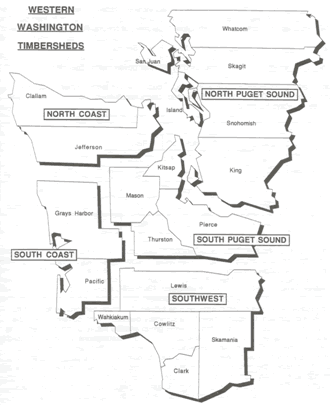 |
| Figure A2. Eastern Washington Timbersheds | |
East Cascades Inland Empire |
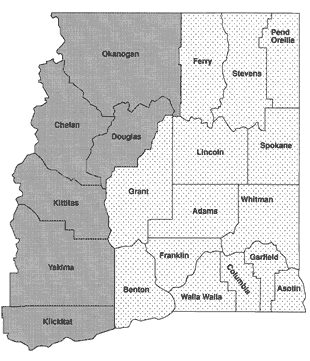 |
Table A3. The New NAICS Hierarchical Structure. The following are the 20 broad sectors (up from the 10 divisions of the SIC system): |
|
| XX | Industry Sector (20 broad sectors up from 10 SIC) |
| XXX | Industry Subsector |
| XXXX | Industry Group |
| XXXXX | Industry |
| XXXXXX | U.S., Canadian, or Mexican National specific |
| Code | NAICS Sectors |
| 11 | Agriculture, Forestry, Fishing and Hunting |
| 21 | Mining |
| 22 | Utilities |
| 23 | Construction |
| 31-33 | Manufacturing |
| 42 | Wholesale Trade |
| 44-45 | Retail Trade |
| 48-49 | Transportation and Warehousing |
| 51 | Information |
| 52 | Finance and Insurance |
| 53 | Real Estate and Rental and Leasing |
| 54 | Professional, Scientific, and Technical Services |
| 55 | Management of Companies and Enterprises |
| 56 | Administrative and Support and Waste Management and Remediation Services |
| 61 | Education Services |
| 62 | Health Care and Social Assistance |
| 71 | Arts, Entertainment, and Recreation |
| 72 | Accommodation and Food Services |
| 81 | Other Services (except Public Administration) |
| 92 | Public Administration |
| Table A4. Sources of Input Data for the Washington Input-Output Model (NAICS) |
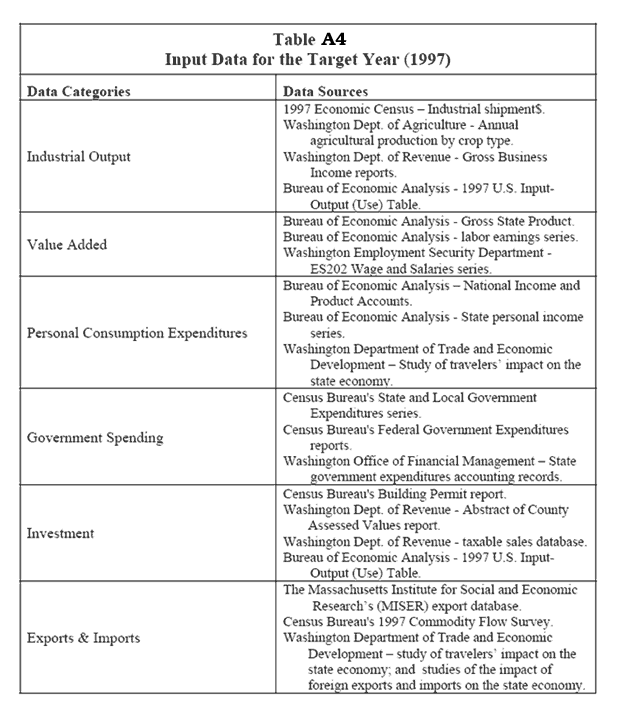 |
| Table A5. The 39 Industrial Sectors in the Washington Input -Output Model (NAICS) |
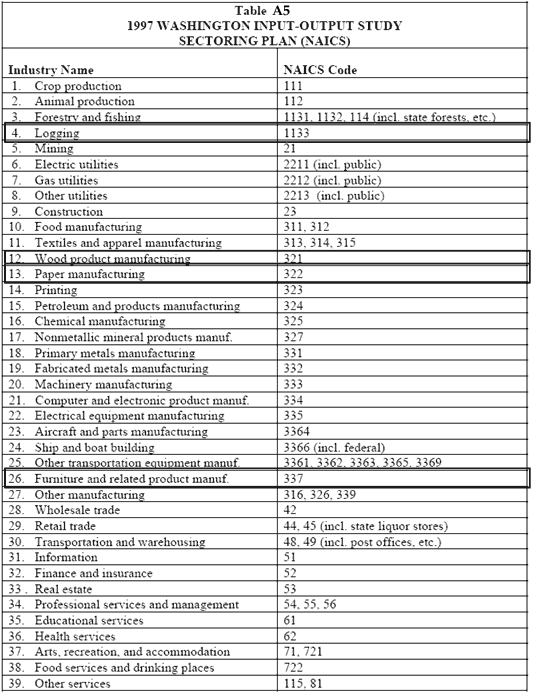 |
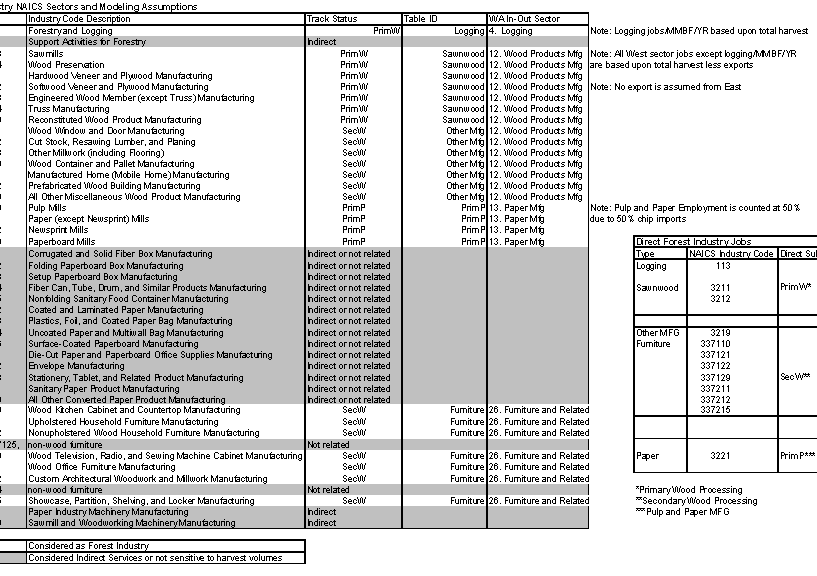
Table A7. Forest Industry and Wood Processing Sectors by NAICS Classification Codes with estimated annual and average employment.(WA Employment Security Department) |
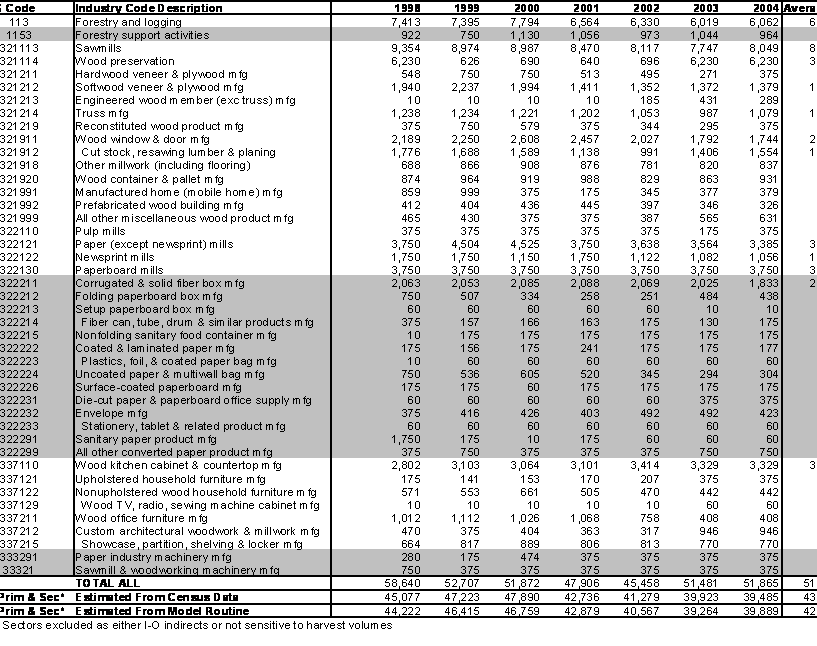
| Table A8. Average Annual Wages by Sector for the Forest industry from I-O Analysis(2004 $) | |||||||
| Logging | Sawnwood | PrimW (sub) | Other Mfg | Furniture | SecW (sub) | PrimP | All |
| $36,131 | $39,700 | $38,451 | $39,699 | $29,810 | $34,532 | $60,134 | $39,399 |
| Average Annual Wages by Sector for the Forest industry from Survey Data (2007 $) | |||||||
| Logging | Sawnwood | PrimW (sub) | Other Mfg | Furniture | SecW (sub) | PrimP | All |
| $36,132 | $39,695 | $60,112 | |||||
Table A9. Average Annual Wages by Sector from Quarterly Census of Employment and Wages, Employment Security Department. |
Table A10. Washington Economy 2003-2004 |
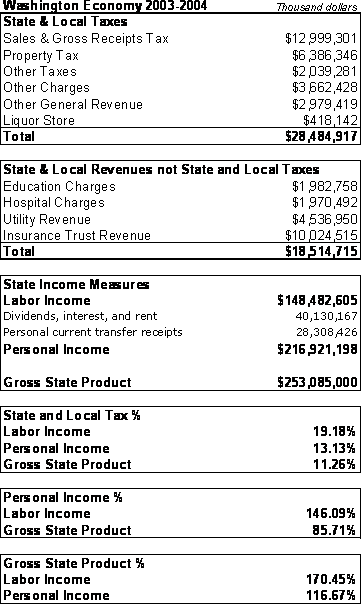 |
(US Census Department , Washington Office of Financial Management, U.S. Bureau of Economic Analysis) |
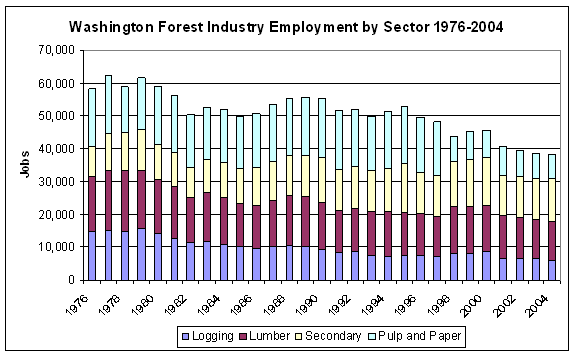 |
| Figure A3. Washington Forest Industry Employment by Sector 1976-2004. |
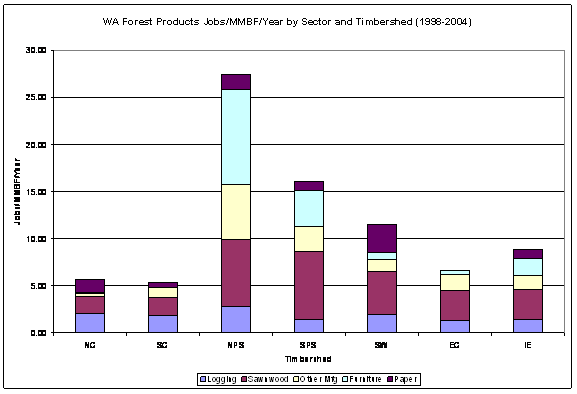 |
| Figure A4. WA Forest Products Jobs/MMBF/Year by Sector and Timbershed (1998-2004) |
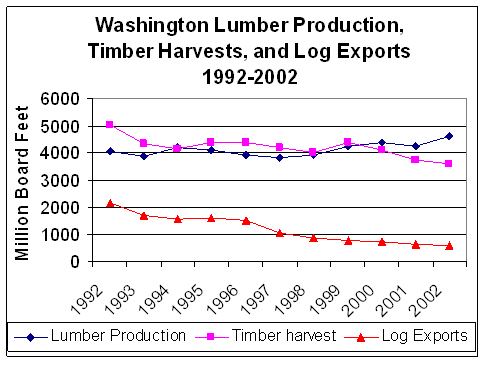 |
| Figure A5. Washington Lumber Production, Timber Harvests, and Log Exports 1992-2002. |
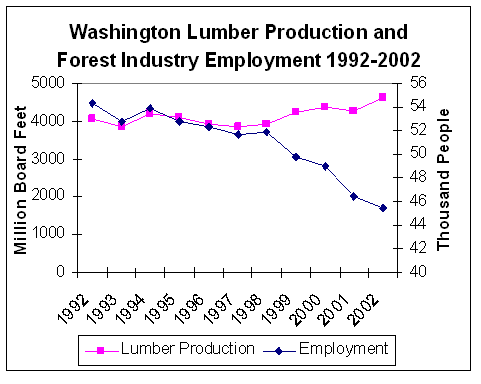 |
| Figure A6. Washington Lumber Production and Forest Indiustry Employment 1992-2002.
Source: DNR Harvest Reports; Warren 2005. |
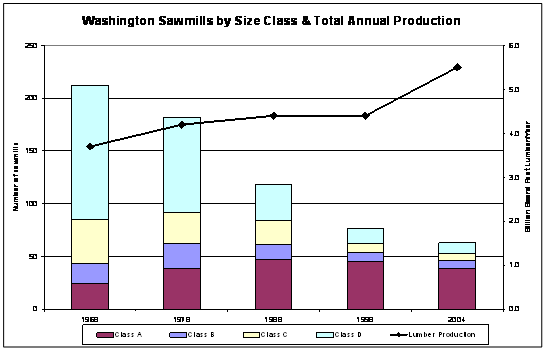 |
| Figure A7. Washington Sawmills by Size Class and Total Production.
Class D mills produce less than 10MMBF/Yr; Class C mills produce 10-20 MMBF/Yr; |
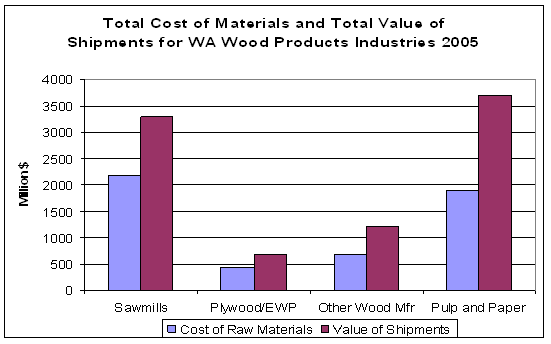 |
| Figure A8. Total Cost of Materials and Total Value of Shipments for WA Wood Products Industries 2005.
Source: Annual Survey of Manufacturers. U.S. Census Bureau. |