|
 |
 |
 |



 |
|
 |
|
 |
|
 |
|
 |
|
 |
|
 |
|
 |
|
 |
|
 |
|
 |
|
 |
|
 |
|
MeasurementStandard Reporting Basis•Imperial to metric conversion factors U.S. Softwood Veneer and Plywood1. Converting surface measure of any thickness to the 3/8 inch basis Hardwood Veneer and PlywoodRecovery EfficiencyMaterial Balance Green-End RecoveryMaterial Balance Dry-End RecoveryRecovery Efficiency Measures•Relationship between CRR and VRF •Veneer recovery and board foot log scale Weight of Veneer and Plywood
Square Meter, 1 mm Basis. The standard basis for reporting plywood and veneer in countries on the metric system is the square meter, 1 mm basis. This represents a piece 1 m square and 1 mm thick, or 1/1,000 cubic meter. Imperial to Metric Conversion Factors for Plywood. Table 5-2 presents commonly used conversions. U.S. Softwood Veneer and Plywood Veneer Sheet Thickness. Softwood
veneer thicknesses usually range from 1/16 to 5/16 inch, with the
most common being 1/10, 1/8, and 1/6 inch. Thicknesses are often
expressed by mills in thousandths of an inch. The lathe setting
is somewhat larger to account for compression during peeling, peeling
variation, and shrinkage during drying. Procedures to calculate
the green target thickness at the lathe are similar to those for
lumber explained in Chapter 4 (pp. 58-59). Volume of Veneer or Panels: SF3/8= SMt * (t / 0.375) = 2.667 * t * SMt. Column 4 of Table 5-1 lists values of t/0.375. Veneer is marketed on the basis of nominal dimensions;
the square footage of 1/10 inch full sheets is generally calculated
on the basis of nominal dimensions such as 4 by 8 feet and excludes
the oversizing required for trim and shrinkage. To estimate the
total wood fiber represented, increase the square footage by about
12% (Fahey 1987) or measure a sample of sheets and calculate the
adjustment factor needed. Table
5-1. Conversion of actual panel thickness to
standard thickness basis.
Source: Calculated by the author. Table
5-2. Imperial-metric conversion factors for plywood.
Source: Calculated by the author. Note: The values in the rows for 1,000 m2, 1 mm basis and for m3 are identical since a 1,000 m2 area that is 1 mm thick represents 1 m3 of volume.
2. Cubic Foot Calculation.
The volume, in cubic feet, of a single 4 by 8 foot panel of
thickness t inches is
ft3 = (4 * 8 feet) * t / 12 = 32 * t / 12. Hence the volume of a 1/2 inch thick panel is 1.3333 cubic feet. Substituting other thicknesses results in column 2 of Table 5-4.When the 3/8 inch thickness is substituted into this formula, the volume of a 4 by 8 foot panel is exactly one cubic foot. In general, the formula to convert the SF3/8equivalent of any panel thickness to cubic feet is ft3 = SF3/8 * (3/8) / 12 = SF3/8/ 32. In section 1 above, it was found that 1,500 square feet of 1/2 inch plywood was equivalent to 2,000 square feet on the 3/8 basis. Substituting this into the above formula results in an equivalent of 62.5 cubic feet of plywood. If the formula in section 1, which converts surface measure of any thickness to the 3/8 basis, is substituted for SF3/8, the following general relationship is foundft3 = [SMt * (t / 0.375)] / 32 = SMt * t / 12 = 0.08333 * t * SMt. This formula directly converts the square footage of any original thickness to cubic feet equivalent. Values of 0.08333 * t are tabulated in column 3 of Table 5-4. The values in column 3 can also be obtained by dividing the cubic foot volume of a 4 by 8 foot panel of given thickness (column 2) by 32 square feet per panel. With this calculation, column 3 can be interpreted as the number of cubic feet of panel per square foot of panel of the indicated thickness. See Example 2.Since 1,000 square feet (MSF) is a common unit, column 4 reexpresses column 3 in cubic feet per MSF and column 5 converts cubic feet per MSF to cubic meters per MSF. For example, Table 5-4 shows that 1,000 square feet of 3/8 inch plywood is equivalent to 31.25 cubic feet or 0.89 cubic meters. Reciprocals of these values indicate that, for 3/8 inch plywood, there are 0.032 MSF (32.0 square feet) per cubic foot and 1.124 MSF (1,124 square feet) per cubic meter. These formulas and methods can be used to obtain the cubic foot volume of finished panels or nominally measured veneer. To determine the cubic foot volume of green veneer needed to make the panel, increase the result by 12% to account for layup and trim losses (Fahey 1987). 3. Cubic Meter Calculation. Outside North America, veneer and plywood are produced in metric sizes: width (W) and length (L) in meters, thickness (t) in millimeters. Statistics are normally reported in square meters surface measure (on a 1 mm basis) or cubic meters. Formulas are SMt = L * W = surface measure, m2, of original thickness. SM1 = SMt *t = surface measure, m2, 1 mm basis. m3 = SMt* t / 1,000 = SM1 / 1,000.
Example 1 To convert 1,500 square feet of 1/2 inch panels to 3/8 inch basis: SF3/8 = 1,500 * (0.5 inch / 0.375 inch). = 1,500 * 1.3333 = 2,000 square feet. The value 1.3333 is also found in Table 5-1, column 4, corresponding to 1/2 inch thickness. To convert 1,000 square feet of 1/10 inch veneer to 3/8 inch basis: SF3/8 = 1,000 * (0.1 inch / 0.375 inch) = 267 square feet. Example 2 to the 3/8 basis Multiply 1,500 by 1.3333 (column 4, Table 5-1) to get 2,000 ft23/8. This is the same result obtained by the formula in section 1 (and Example 1). to cubic feet (four equivalent calculations are shown) . ft3 = SF3/8 * 32 = 2,000 / 32 = 62.5. . ft3 = 0.08333 * SMt * t = 0.08333 * 1,500 * 1/2 = 62.5. . Multiply 1,500 by 0.0417
(column 3, Table 5-4) . Multiply 1.5 MSF by 41.7
(column 4, Table 5-4) to cubic meters Multiply 1.5 MSF by 1.18 (column 5, Table 5-4) Table 5-3. Softwood plywood panel sizes.
Source: USDC (1983a). Note: Panel thickness is measured at 9% MCod. Panel sizes other than those specified are available on special order. Table 5-4. Standard plywood thickness with conversions to cubic volume.
Source: Calculated by the author.
Hardwood plywood is similar to
softwood plywood. The main differences in North America are that
hardwood plywood is more typically produced for appearance uses,
thus affecting the sizes of veneers and panels, and it is more
common to find hardwood "plywood" where materials other
than veneer (particleboard, hardboard, etc.) are used as core
stock.
Veneer Sizes. Hardwood veneers are produced in a variety of ways. While softwood veneer is predominantly rotary cut from logs, hardwood veneer may be rotary cut or sliced. Usual slicing options are plain cut, quarter cut, half round, or rift cut. Each of these cutting patterns produces a unique grain pattern in the veneer. The raw material for slicing is commonly a flitch sawn from a log in such a way as to expose one of the desired grain patterns. Veneer is manufactured in thicknesses ranging from 1/50 to 1/4 of an inch, though on special order it can range from 1/200 to 1/2 inch. An average value to use would be either 1/16 or 1/32 inch, with 1/16 being the average of maximum and minimum thicknesses across the industry. Specifications and terminology for hardwood and decorative plywood are described in Product Standard PS 51-71 (USDC 1971). The standard specifies only the maximum thickness of veneer, which varies depending on species category and plywood type. The range of maximum standard thicknesses is from 1/12 to 1/4 inch. Flitches may be random length but often are in whole foot increments. Flitches may also include some of the round curvature of the log, so each slice of veneer from a flitch may be of a different width. Slices are trimmed to have parallel edges. Slices from a flitch may be random width or trimmed to a uniform width. Customs for manufacture of veneer differ between North America and overseas producers. Plywood Panel Sizes. Hardwood plywood is more of a speciality product than softwood plywood is. As such, it comes in a variety of sizes and shapes, both standard and nonstandard. Common panel sizes are 48 inches wide in 84, 96, and 120 inch lengths and 1/8 to 3/4 inch thicknesses. The most common size encountered on the retail market is a 4 by 8 foot sheet in 3/8 inch thickness. Due to the speciality nature of hardwood plywood, the specifications of a panel are determined more by the buyer than the mill. The buyer can also specify the core material of the panel. There are a number of options in core materials such as softwood or hardwood veneer, softwood or hardwood lumber, particleboard, hardboard, waferboard, and other specialty materials. It has been estimated that about 38% of the production volume of cores is softwood material (USDC 1987). Manufacturing tolerances for panels are listed in Table 5-5. Table 5-5. Hardwood plywood panel tolerances.
Source: USDC (1972); PS 51-71. Volume of Veneer or Panels. The
methods discussed above for softwoods apply. Hardwood veneer is
usually reported on a surface measure basis. To convert this to
cubic feet, use the thicknesses mentioned earlier, remembering
to convert them to feet. For 1/32 inch veneer use 0.0026 and for
1/16 inch use 0.0052 as the conversion factors from square foot
to cubic foot.
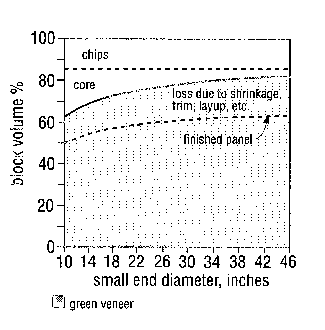
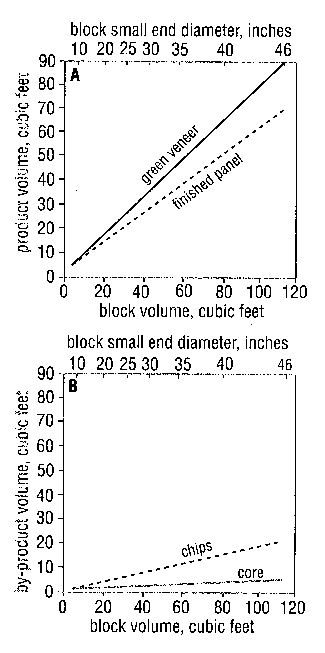
Material Balance Green-End Recovery The green end of a plant refers to all manufacturing activities up to the point of drying veneer; the product of this portion of the plant is clipped green veneer. Many facilities exist that produce and market green veneer.
Theoretical Material Balance. Another
approach for predicting elements of the material balance is to
estimate them from simple mathematical relationships. See, for
example, the following elements (in cubic feet): where ds = small end diameter of block, dl = large end diameter of block,
L = block length, in feet dc = diameter of core, in inches L1 = veneer length between spur
Material BalanceDry-End Recovery The material balance presented in Figures 5-1 and 5-2 also shows recovery after "dry-end" activities, including drying veneer, reclipping, assembly into plywood, and panel trimming. Volume change due to veneer shrinkage is 2 to 3%. Other losses, mainly panel trim and sanding, are about 9 to 10%. Sometimes these dry-end processes are integrated with the green-end facilities in the same plant and in other cases they are independent. Dry-end recoveries can be expressed either on an original block volume basis or in terms of green veneer recovered, as illustrated in Table 5-6, which shows that 59.1% of the original block volume (78.2% of the green veneer recovered) finds its way into the finished panel.
Source: Fahey (1987).
The above measures are typically based on the nominal panel thickness (i.e., 1/8 inch, 1/10 inch, etc.) and can be amended by using the actual thickness setting on the lathe. This is typically larger than the nominal thickness to account for shrinkage, compression, thickness variation, and so forth. Green target cubic recovery ratio (CRRgt) can be expressed for either the nominal length and width of sheets or using the actual green sizes. Veneer Recovery Factor (VRF). Veneer recovery factor is the SF3/8basis of recovered veneer divided by the cubic feet of log volume. VRF can be calculated as a counterpart to CRR for each of the degrees of manufacture discussed in the previous section. The USFS timber assessment estimates a national average of 14.1 square feet of 3/8 inch nominal veneer per cubic foot of log used (Appendix 2). Relationship Between CRR and VRF. Since CRR = veneer, ft3 / log, ft3, VRF = SF3/8/ log, ft3, and veneer, ft 3 = SF3/8 / 32, one can derive VRF3/8 = 32 * CRR. See Example 3.If a thickness basis (t) other than 3/8 inch is desired, remember that SF3/8= SM * (t / 0.375), hence VRFt = 12 * CRR / t. Since CRR and VRF can be measured for different states of manufacture (i.e., green vs. dry veneer), it is important to maintain consistency. Veneer Recovery
and Board Foot Log Scale. VRR historically has been between 2.5 and 3.0 SF3/8per BF for various board foot log
scales. Re-cent improvements in technology, combined with smaller
logs that are underscaled in Scribner log scale, are pushing CRR
above 3.0. Because of the behavior of some BF log rules, the VRR
measure, like overrun for lumber, can be very sensitive to small
changes in block diameter and other factors unrelated to milling.
VRR does not behave in a consistent manner and thus is not a recommended
measure of mill efficiency.
Example 3 Block volume (Smalian's formula) 12.6 ft3 Recovery 1/10 inch veneer based on full dimension
of Lineal footage of 1/10 inch veneer
= 1/10 inch veneer based on nominal
dimension of sheets, 3/8 inch basis: Cubic feet: Actual = 208/32 6.5 ft3 Nominal = 183/32 5.7 ft3 Cubic recovery ratio (CRRrg): Actual = 6.5/12.6 0.51 or 51% Nominal = 5.7/12.6 0.45 or 45% Veneer recovery factor (VRFrg): 3/8 inch basis: Actual = 208/12.6 16.5 ft2/ft3 Nominal = 183/12.6 14.5 ft2/ft3 Veneer recovery related to Scribner volume: 3/8 inch basis: Scribner volume of a 16 inch x 8 foot block = 80 BF VRF-Scribner = 208/80 = 2.6 ft2/BF |
|||||||||||||||||||||||||||||||||||||||||||||||||||||||||||||||||||||||||||||||||||||||||||||||||||||||||||||||||||||||||||||||||||||||||||||||||||||||||||||||||||||||||||||||||||||||||||||||||||||||||||||||||||||||||||||||||||||||||||||||||||||||||||||||||||||||||||||||||||||||||||||||||||||||||||||||||||||||||||||||||||||||||||||||||||||||||||||||||||||||||||||||||||||||||||||||||||||||||||||||||||||||||||||||||||||||||||||||||||||||||||||||||||||||||||||||||||||||||||||||||||||||||||||||||||||||||||||||||||||||||||||||||||||||||||||||||||||||||||||||||||||||||||||||||||||||||||||||||||||||||||||||||||||||||||||||||||||||||||||||||||||||||||||||||||||||||||||||||||||||||||||||||||||||||||||||||||||||||||||||||||||||||||||||||||||||||||||||||||||||||||||||||||||||||||||||||||||||||||||||||||||||||||||||||||