|
 |
 |
 |



 |
|
 |
|
 |
|
 |
|
 |
|
 |
|
 |
|
 |
|
 |
|
 |
|
 |
|
 |
|
 |
|
Chapter 1. Basic Wood Properties
Moisture ContentFormulas
•Moisture content on an oven-dry basis
•Moisture content on a wet or original Conversion Between MCod and MCw Fiber
Saturation Point (fsp),
Shrinkage, and Swelling
|
|||||||||||||||||||||||||||||||||||||||||||||||||||||||||||||||||||||||||||||||||||||||||||||||||||||||||||||||||||||||||||||||||||||||||||||||||||||||||||||||||||||||||||||||||||||||||||||||||||||||||||||||||||||||||||||||||||||||||||||||||||||||||||||||||||||||||||||||||||||||||||||||||||||||||||||||||||||||||||||||||||||||||||||||||||||||||||||||||||||||||||||||||||||||||||||||||||||||||||||||||||||||||||||||||||||||||||||||||||||||||||||||||||||||||||||||||||||||||||||||||||||||||||||||||||||||||||||||||||||||||||||||||||||||||||||||||||||||||||||||||||||||||||||||||||||||||||||||||||||||||||||||||||||||||||||||||||||||||||||||||||||||||||||||||||||||||||||||||||||||||||||||||||||||||||||||||||||||||||||||||||||||||||||||||||||||||||||||||||||||||||||||||||||||||||||||||||||||||||||||||||||||||||||||||||||||||||||||||||||||||||||||||||||||||||||||||||||||||||||||||||||||||||||||||||||||||||||||||||||||||||||||||||||||||||||||||||||||||||||||||||||||||||||||||||||||||||||||||||||||
| Condition |
Volume (ft3)
|
Weight |
| Green |
0.78
|
40.0 |
| Kiln-dry |
0.73
|
22.3 |
| Oven-dry | 0.68 | 19.4 |

Formulas
Wood moisture content may be expressed in either of two ways, hence it is important to know which is being used. Using the data above, the following formulas show how to find the percentage of moisture on an oven-dry basis (MCod) or on a wet or original basis (MCw).
Moisture Content on an
Oven-dry Basis (MCod)
MCod = 100
* weight of water / oven-dry weight
= 100 *
(22.3 – 19.4)/19.4 = 15% kiln-dry
= 100
* (40.0 –
19.4)/19.4 = 106% green
MCod is commonly
used in solid wood industries such as lumber and plywood. Note
that on this basis, moisture content
can exceed 100%.
Moisture Content on a
Wet or Original Basis (MCw)
MCw = 100 * weight of water/original weight
= 100
* (22.3 – 19.4)/22.3
= 13% kiln-dry
= 100
* (40.0 – 19.4)/40.0
= 52% green
MCw is commonly used in the pulp and paper and the wood energy industries. Note that on this basis, moisture content can never reach 100%.
Conversion Between MCod and MCw
MCod
= 100
* MCw / (100 – MCw)
MCw = 100 * MCod / (100 +
MCod)
Fiber Saturation Point (fsp), Shrinkage, and Swelling
When wood dries below a certain moisture content, referred to as the fiber saturation point (fsp), it begins to shrink and continues to do so until it is oven-dry. Conversely, wood that is below fsp will swell as it takes on moisture and this will continue until fsp is reached. Changes in moisture content above fsp have no effect on shrinkage and swelling. Fsp varies among species, but a value of 30% MCod (23% MC style='font-size:9.0pt'>w) is commonly assumed.
Table 1-1<. Moisture content, shrinkage, and specific gravity of some western
species.
|
|
|
|
Moisture content (MCod) |
|
|
|
|
|
||||||||||||||||||||||||||
|
Species |
Sap |
|
Heart |
|
T |
R |
V |
|
Avg |
Low |
High |
|||||||||||||||||||||
|
|
||||||||||||||||||||||||||||||||
|
SOFTWOODS |
|
|
|
|
|
|
|
|
|
|
|
|||||||||||||||||||||
|
|
|
|
|
|
|
|
|
|
|
|
|
|
|
|||||||||||||||||||
|
Cedar |
|
|
|
|
|
|
|
|
|
|
|
|
||||||||||||||||||||
|
Alaska |
166 |
|
32 |
|
6.0 |
2.8 |
9.2 |
|
0.42 |
0.34 |
0.50 |
|
||||||||||||||||||||
|
Incense |
213 |
|
40 |
|
5.2 |
3.3 |
7.7 |
|
0.35 |
0.28 |
0.42 |
|
||||||||||||||||||||
|
Port Orford |
98 |
|
50 |
|
6.9 |
4.6 |
10.1 |
|
0.39 |
0.31 |
0.47 |
|
||||||||||||||||||||
|
Western
redcedar |
249 |
|
58 |
|
5.0 |
2.4 |
6.8 |
|
0.31 |
0.25 |
0.37 |
|
||||||||||||||||||||
|
Douglas-fir (coast) |
115 |
|
37 |
|
7.6 |
4.8 |
12.4 |
|
0.45 |
0.36 |
0.54 |
|
||||||||||||||||||||
|
|
|
|
|
|
|
|
|
|
|
|
|
|
||||||||||||||||||||
|
Fir |
|
|
|
|
|
|
|
|
|
|
|
|
||||||||||||||||||||
|
Grand |
136 |
|
91 |
|
7.5 |
3.4 |
11.0 |
|
0.35 |
0.28 |
0.42 |
|
||||||||||||||||||||
|
Noble |
115 |
|
34 |
|
8.3 |
4.3 |
12.4 |
|
0.37 |
0.30 |
0.44 |
|
||||||||||||||||||||
|
Pacific silver |
164 |
|
55 |
|
9.2 |
4.4 |
13.0 |
|
0.40 |
0.32 |
0.48 |
|
||||||||||||||||||||
|
White |
160 |
|
98 |
|
7.0 |
3.3 |
9.8 |
|
0.37 |
0.30 |
0.44 |
|
||||||||||||||||||||
|
Hemlock, western |
170 |
|
85 |
|
7.8 |
4.2 |
12.4 |
|
0.42 |
0.34 |
0.50 |
|
||||||||||||||||||||
|
Larch, western |
110 |
|
54 |
|
9.1 |
4.5 |
14.0 |
|
0.48 |
0.38 |
0.58 |
|
||||||||||||||||||||
|
Pine |
|
|
|
|
|
|
|
|
|
|
|
|
||||||||||||||||||||
|
Lodgepole |
120 |
|
40 |
|
6.7 |
4.3 |
11.1 |
|
0.38 |
0.30 |
0.46 |
|
||||||||||||||||||||
|
Ponderosa |
148 |
|
40 |
|
6.2 |
3.9 |
9.7 |
|
0.38 |
0.30 |
0.46 |
|
||||||||||||||||||||
|
Sugar |
219 |
|
98 |
|
5.6 |
2.9 |
7.9 |
|
0.34 |
0.27 |
0.41 |
|
||||||||||||||||||||
|
Western white |
148 |
|
62 |
|
7.4 |
4.1 |
11.8 |
|
0.35 |
0.28 |
0.42 |
|
||||||||||||||||||||
|
Redwood |
|
|
|
|
|
|
|
|
|
|
|
|
||||||||||||||||||||
|
Old growth |
210 |
|
86 |
|
4.4 |
2.6 |
6.8 |
|
0.38 |
0.30 |
0.46 |
|
||||||||||||||||||||
|
Young growth |
— |
|
— |
|
4.9 |
2.2 |
7.0 |
|
0.34 |
0.27 |
0.41 |
|
||||||||||||||||||||
|
|
|
|
|
|
|
|
|
|
|
|
|
|
||||||||||||||||||||
|
HARDWOODS |
|
|
|
|
|
|
|
|
|
|
|
|
||||||||||||||||||||
|
|
|
|
|
|
|
|
|
|
|
|
|
|
|
|||||||||||||||||||
|
Red alder |
97 |
|
— |
|
7.3 |
4.4 |
12.6 |
|
0.37 |
0.30 |
0.44 |
|
||||||||||||||||||||
|
Oregon ash |
— |
|
— |
|
8.1 |
4.1 |
13.5 |
|
0.50 |
0.40 |
0.60 |
|
||||||||||||||||||||
|
Black cottonwood |
— |
|
— |
|
8.6 |
3.6 |
12.4 |
|
0.31 |
0.25 |
0.37 |
|
||||||||||||||||||||
|
Bigleaf maple |
— |
|
— |
|
7.1 |
3.7 |
11.6 |
|
0.44 |
0.35 |
0.53 |
|
||||||||||||||||||||
|
|
|
|||||||||||||||||||||||||||||||
|
Source: USFS (1987). aShrinkage: T = tangential, R = radial, V = volumetric. (Longitudinal shrinkage of normal wood is very low and is usually ignored.) bThe specific gravity range is calculated assuming a coefficient of variation of 20%. Under this assumption 95% of the population should have a specific gravity within the calculated range.
|
|
|||||||||||||||||||||||||||||||
Calculating Shrinkage (Sh) Percentage
Sh = 100 * decrease in size / original size. Here the "size" could be length, width, thickness, or overall volume, hence the formula can be used to calculate longitudinal shrinkage (Shl), volumetric shrinkage (Shv), or shrinkage in other directions. Table 1-1 presents shrinkage data for several western species and illustrates the variability between species and the differences due to grain direction in wood. In dealing with conversion factors, one is most often concerned with changes in volume, hence volumetric shrinkage values are of interest. Using the 2x4 data, total volumetric shrinkage (green to oven-dry) is
Shvt = 100 * (0.78 – 0.68)/0.78 = 12.8%.
Similarly, volumetric shrinkage green to kiln-dry (15% MCod) is
Shv15 = 100 * (0.78 – 0.73)/0.78 = 6.4%.
In the absence of actual measurement data, shrinkage from green to any intermediate moisture content, x, can be calculated by interpolation. Using volumetric shrinkage as an example
Shvx = Shvt * (fsp – MCod, x)/fsp.
Assuming fsp is MCod = 30%, the volumetric shrinkage from green to kiln-dry (MCod, x = 15) is
Shv15 = 12.8 * (30 – 15)/30 = 6.4%.
Calculating Swelling (Sw) Percentage
Sw = 100 * increase in size / original size.
Suppose a contractor placed the kiln-dried 2x4 outdoors for several weeks during a rainy period and that it has returned to the green size. The percentage of swelling is
Sw = 100 * (0.78 – 0.73)/0.73 = 6.8%.
This example illustrates that swelling and shrinkage percentages are not equal, since calculation of each is based on the starting dimension. Calculations for swelling in specific directions are similar.
Typical Moisture Contents of Wood
Equilibrium Moisture Content (EMC). Wood exposed to air with a constant temperature and relative humidity will eventually reach a constant moisture content called equilibrium moisture content (EMC). EMC normally reflects moisture content expressed on an oven-dry basis. EMC varies with both humidity and temperature, with the former dominating. Changes in humidity and temperature cause wood products to move toward a new EMC level. The values listed below indicate the range of EMC that various products will reach at a temperature of 70oF (21oC) for relative humidities of 30 to 90% (Haygreen and Bowyer 1989).
|
MCod
(%)
|
|
|
|
|
|
Wood (e.g., lumber)
|
6.0 - 21.6
|
|
Softwood plywood
|
6.0 - 19.0
|
|
Particleboard
|
6.6 - 16.6
|
|
Oil-treated hardboard
|
4.0 - 10.8
|
|
High pressure laminate
|
3.0 -09.1
|
Kiln-Dried Products. Many wood products are dried during manufacture to a moisture content that approximates the EMC they will experience in their final use. This tends to minimize dimension changes due to shrinkage and swelling during use. By reducing weight, kiln drying may also reduce freight charges.
Air-Dried Products. The moisture content of air-dried products in outdoor situations is variable because of the seasonal changes in the environment. However, a reasonable average would be approximately 20% MCod.
Green Products. The moisture content of green or fresh wood as found in the living tree or logs is highly variable and depends on species, locale, season of the year, and heartwood and sapwood content of the wood. Table 1-1 presents green MCod for some western species and illustrates the variation that can be encountered. Some products, especially lumber, are often sold in the green condition with the expectation that they will air-dry sufficiently before use. If this does not occur, difficulties with excessive shrinkage may result.
Density and Specific Gravity
Density
Wood density is simply its weight per unit volume, hence this measure has units such as lb/ft3. Synonyms sometimes used are weight density and bulk density. For these to be meaningful, the moisture content at which the weight and volume were measured must be indicated; in some cases weight and volume are at the same moisture content while in other cases they are at different moisture contents.
For example, the green weight of the 2x4 (40.0 lb) can be divided by its green volume (0.78 ft3), its kiln-dry volume (0.73 ft3), or its oven-dry volume (0.68 ft3), resulting in densities of 51.3, 54.8, and 58.8 lb/ft3, respectively. Example 1 lists these as the first row of values. The second row represents densities when the kiln-dry weight is divided by the three volume measures, and the bottom row represents densities when the oven-dry weight is used.
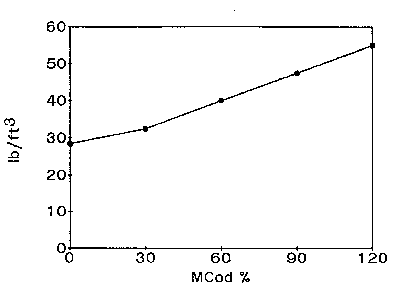
In Example 1, the density 51.3 lb/ft3 would be useful for predicting the weight of green 2x4s that must be handled by labor and machinery in the sawmill. The density 34.9 lb/ft3 can be applied only to actual cubic lumber volumes measured after drying to 15% MCod; it would estimate the shipping weight of the dried lumber. The density 32.7 lb/ft3 could be used to predict the shipping weight of kiln-dried 2x4s from the cubic volume measured when the lumber is in the green condition. Each of the remaining six density values has a particular interpretation and application. This example illustrates that merely stating the units of weight and volume (i.e., lb/ft3) is ambiguous without further statement of the moisture content at which each of these measurements was taken. It should be obvious that there are an infinite number of weight densities and that weight density of wood varies continuously with moisture content, as shown by Figure 1-1. The kink in the curve is due to the effect of shrinkage on volume when moisture content is below fsp.
Figure 1-1. Effect of moisture content on density, SGg = 0.40.
Specific Gravity
Specific gravity is the density of wood relative to the density of water, and for this reason the terms relative density and basic density are sometimes used. Specific gravity is used as a basis to standardize comparisons among species and products. To reduce confusion from varying moisture content, specific gravity of wood is based on oven-dry weight and volume measured at one of the following MCod conditions: 0% (oven-dry), 12%, or green. These will be referred to in this book as SGod, SG12, and SGg. When referring to specific gravity, it is important to indicate which of these volume bases is used. SG12 is often reported in the literature, because MCod = 12% is a standard moisture content at which many wood properties are tested. SGg is commonly reported due to the relative ease of measurement.
|
|
The volume and weight data presented
for the 2x4 can be combined
into nine densities (lb/ft3):
Volume basis
|
Kiln-dry
|
Oven
|
||
| Weight basis |
Green
|
(MCod = 15% )
|
dry
|
| Green |
51.3
|
54.8
|
58.8
|
| Kiln-dry |
32.7
|
34.9
|
37.5
|
|
(MCod =15%)
|
|||
| Oven-dry |
24.9
|
26.6
|
28.5
|
|
|
Example 2
Continuing the 2x4 example, and noting that water weighs 62.4
lb/ft3:
SGg = 24.9
lb/ft3
/ 62.4 lb/ft3 = 0.40.
SGod = 28.5
lb/ft3 / 62.4 lb/ft3
= 0.46.
|
|
Example 3
Calculate SG15 for the 2x4.
Previously, it was found that Shv15 = 6.4%.
Therefore
SG15 = 0.40/(1
– 6.4/100) = 0.427 ~ 0.43.
This value could
also be calculated directly using the density from Example 1. The
correct density to use is that with an oven-dry weight and volume
taken when kiln-dry. Thus
SG15 = 26.6
/ 62.4 = 0.426 ~ 0.43.
The
slight difference is due to rounding.
|
|
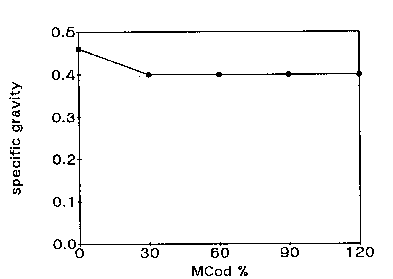
Note in Example 2 that the units of measure cancel, so specific gravity is unitless. Also, note that specific gravity for this wood has risen from 0.40 to 0.46 as the volume basis changed from green to oven-dry. This is due to the effect of volumetric shrinkage below fsp. Above fsp, volume does not change; so specific gravity is the constant green basis value. Figure 1-2 plots specific gravity against MCod. The kink corresponds to the onset of volumetric shrinkage below fsp. Table 1-1 presents the average and range of SGg for some western species.
Figure 1-2.
Effect of moisture content on specific gravity, SGg = 0.40.
Frequently, data on specific gravity at a particular moisture content basis may not be available. The following formula can be used to estimate SG at MCod = x:
SGx = SGg /(1 – Shvx/100) 0 ≤ x ≤fsp.
See Example 3.
Calculating the Weight of Wood Products
The most accurate method for estimating weight is to weigh representative samples. In cases involving transportation, shippers often have weight tables that should be used. In situations where sampling is not possible and shipping tables are not available, the methods in this section can be used. The reader should be aware that wood is variable and an estimate based on published averages for a species may differ substantially from reality. For example, the author was involved in a request to estimate the weight of a large redcedar log. Since the dimensions were carefully measured, the estimate of cubic volume was regarded as reasonably accurate. But there was no information on the specific gravity or moisture content of this log. The estimated weight, based on redcedar averages shown in Table 1-1, was about one-third the actual weight later obtained on a truck scale. The log had either a higher average specific gravity, higher moisture content, or both.
Example 4
A debarked log contains 44 ft3 of wood and it is desired to determine the load it will place on a conveyor. Assuming the SGg of the species involved is 0.40 and that the log has an MCod of 60%, its weight is
44 ft3 * 0.40 * 62.4 lb/ft3 * (1 + 60/100) = 1,757 lb.
Since
the log is in the green condition and specific gravity
is on a green volume basis, the units are consistent.
Example 5
Suppose
instead that a pulp mill wished to estimate the weight of oven-dry
fiber contained in the log of
Example 4.
44 ft3 * 0.40 * 62.4 lb/ft3 * (1 + 0/100) = 1,098 lb.
As in Example 4, the log volume is green, hence specific gravity on a green volume basis should be used.
Example 6
Suppose
the log in the previous examples is processed into 2x4s as discussed
earlier and that the recovery of dry (15% MCod) 2x4s is 45% of the cubic volume of the
log. Thus there is a stack of dried 2x4s which, if measured precisely,
contain 0.45 * 44 = 19.8 ft3.
Referring to the weight calculation formula, the moisture content
is known to be 15%. The specific gravity information available is
SGg = 0.40 and SGod
= 0.46. However, what is needed is the specific gravity based on
volume measured at 15% MCod,
which was found to be 0.43 in Example 3.The
weight of the kiln-dry 2x4s from this log is
19.8 ft3 * 0.43 * 62.4 * (1 + 15/100) = 611 lb.
Assuming the moisture content and specific gravity are known, the weight of wood is calculated as follows:
Weight = (volume) * (specific gravity) *(density of H20) * (1+ MCod /100)
where "volume" is in cubic feet or cubic meters and the density of water is 62.4 lb/ft3 or 1,000 kg/m3. The specific gravity basis should correspond to the moisture content of the volume involved.
SGg is used in both Examples 4 and 5, but in Example 4 the last term includes the weight of water expected in a green log while the weight of water is excluded in Example 5. Remember that specific gravity was defined as always based on density expressed as oven-dry weight per unit volume.
(Go to calculation sheet to calculate weight; Go to calculation sheet to calculate volume)
Figure 1-3. Relation of specific gravity and moisture content. Source: USFS (1987).
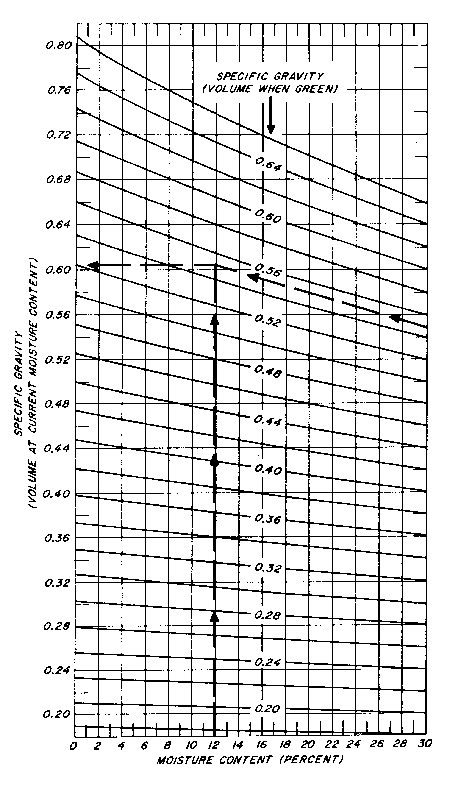
Table 1-2 Density of Wood as a Function of Specific Gravity and Moisture Content (MCod)
Moisture Density in pounds per cubic food when the specific gravity is-
content
of wood 0.30 0.32 0.34 0.36 0.38 0.40 0.42 0.44 0.46 0.48
%
|
0 |
18.7 |
20.0 |
21.2 |
22.5 |
23.7 |
25.0 |
26.2 |
27.5 |
28.7 |
30.0 |
|
4 |
19.5 |
20.8 |
22.1 |
23.4 |
24.7 |
26.0 |
27.2 |
28.6 |
29.8 |
31.2 |
|
8 |
20.2 |
21.6 |
22.9 |
24.3 |
25.6 |
27.0 |
28.3 |
29.6 |
31.0 |
32.3 |
|
12 |
21.0 |
22.4 |
23.8 |
25.2 |
26.6 |
28.0 |
29.4 |
30.8 |
32.2 |
33.5 |
|
16 |
21.7 |
23.2 |
24.6 |
26.0 |
27.5 |
29.0 |
30.4 |
31.8 |
33.3 |
34.7 |
|
20 |
22.5 |
24.0 |
25.5 |
27.0 |
28.4 |
30.0 |
31.4 |
32.9 |
34.4 |
35.9 |
|
24 |
23.2 |
24.8 |
26.3 |
27.8 |
29.4 |
31.0 |
32.5 |
34.0 |
35.6 |
37.1 |
|
28 |
24.0 |
25.6 |
27.2 |
28.8 |
30.4 |
31.9 |
33.5 |
35.1 |
36.7 |
38.3 |
|
32 |
24.7 |
26.4 |
28.0 |
29.7 |
31.3 |
32.9 |
34.6 |
36.2 |
37.9 |
39.5 |
|
36 |
25.5 |
27.2 |
28.9 |
30.6 |
32.2 |
33.9 |
35.6 |
37.3 |
39.0 |
40.7 |
|
40 |
26.2 |
28.0 |
29.7 |
31.4 |
33.2 |
34.9 |
36.7 |
38.4 |
40.2 |
41.9 |
|
44 |
27.0 |
28.8 |
30.6 |
32.3 |
34.1 |
35.9 |
37.7 |
39.5 |
41.3 |
43.1 |
|
48 |
27.7 |
29.6 |
31.4 |
33.2 |
35.1 |
36.9 |
38.8 |
40.6 |
42.5 |
44.3 |
|
52 |
28.5 |
30.4 |
32.2 |
34.1 |
36.0 |
37.9 |
39.8 |
41.7 |
43.6 |
45.5 |
|
56 |
29.2 |
31.2 |
33.1 |
35.0 |
37.0 |
38.9 |
40.9 |
42.8 |
44.8 |
46.7 |
|
60 |
30.0 |
31.9 |
33.9 |
35.9 |
37.9 |
39.9 |
41.9 |
43.9 |
45.9 |
47.9 |
|
64 |
30.7 |
32.7 |
34.8 |
36.8 |
38.9 |
40.9 |
43.0 |
45.0 |
47.1 |
49.1 |
|
68 |
31.4 |
33.5 |
35.6 |
37.7 |
39.8 |
41.9 |
44.0 |
46.1 |
48.2 |
50.3 |
|
72 |
32.2 |
34.3 |
36.5 |
38.6 |
40.8 |
42.9 |
45.1 |
47.2 |
49.4 |
51.5 |
|
76 |
32.9 |
35.1 |
37.3 |
39.5 |
41.7 |
43.9 |
46.1 |
48.3 |
50.5 |
52.7 |
|
80 |
33.7 |
35.9 |
38.2 |
40.4 |
42.7 |
44.9 |
47.2 |
49.4 |
51.7 |
53.9 |
|
84 |
34.4 |
36.7 |
39.0 |
41.3 |
43.6 |
45.9 |
48.2 |
50.5 |
52.8 |
55.1 |
|
88 |
35.2 |
37.5 |
39.9 |
42.2 |
44.6 |
46.9 |
49.3 |
51.6 |
54.0 |
56.3 |
|
92 |
35.9 |
38.3 |
40.7 |
43.1 |
45.5 |
47.9 |
50.3 |
52.7 |
55.1 |
57.5 |
|
96 |
36.7 |
39.1 |
41.6 |
44.0 |
46.5 |
48.9 |
51.4 |
53.8 |
56.3 |
58.7 |
|
100 |
37.4 |
39.9 |
42.4 |
44.9 |
47.4 |
49.9 |
52.4 |
54.9 |
57.4 |
59.9 |
|
110 |
39.3 |
41.9 |
44.6 |
47.2 |
49.8 |
52.4 |
55.0 |
57.7 |
60.3 |
62.9 |
|
120 |
41.2 |
43.9 |
46.7 |
49.4 |
52.2 |
54.9 |
57.7 |
60.4 |
63.1 |
65.9 |
|
130 |
43.1 |
45.9 |
48.8 |
51.7 |
54.5 |
57.4 |
60.3 |
63.1 |
66.0 |
68.9 |
|
140 |
44.9 |
47.9 |
50.9 |
53.9 |
56.9 |
59.9 |
62.9 |
65.9 |
68.9 |
71.9 |
|
150 |
46.8 |
49.9 |
53.0 |
56.2 |
59.3 |
62.4 |
65.5 |
68.6 |
71.8 |
74.9 |
Moisture Density in pounds per cubic food when the specific gravity is-
content
of wood 0.50 0.52 0.54 0.56 0.58 0.60 0.62 0.64 0.66 0.68 0.70
Pct
|
0 |
31.2 |
32.4 |
33.7 |
34.9 |
36.2 |
37.4 |
38.7 |
39.9 |
41.2 |
42.4 |
43.7 |
|
4 |
32.4 |
33.7 |
35.0 |
36.3 |
37.6 |
38.9 |
40.2 |
41.5 |
42.8 |
44.1 |
45.4 |
|
8 |
33.7 |
35.0 |
36.4 |
37.7 |
39.1 |
40.4 |
41.8 |
43.1 |
44.5 |
45.8 |
4.72 |
|
12 |
34.9 |
36.3 |
37.7 |
39.1 |
40.5 |
41.9 |
43.3 |
44.7 |
46.1 |
47.5 |
48.9 |
|
16 |
36.2 |
37.6 |
39.1 |
40.5 |
42.0 |
43.4 |
44.9 |
46.3 |
47.8 |
49.2 |
50.7 |
|
20 |
37.4 |
38.9 |
40.4 |
41.9 |
43.4 |
44.9 |
46.4 |
47.9 |
49.4 |
50.9 |
52.4 |
|
24 |
38.7 |
40.2 |
41.8 |
43.3 |
44.9 |
46.4 |
48.0 |
49.5 |
51.1 |
52.6 |
54.2 |
|
28 |
39.9 |
41.5 |
43.1 |
44.7 |
46.3 |
47.9 |
49.5 |
51.1 |
52.7 |
54.3 |
55.9 |
|
32 |
41.2 |
42.8 |
44.5 |
46.1 |
47.8 |
49.4 |
51.1 |
52.7 |
54.4 |
56.0 |
57.7 |
|
36 |
42.4 |
44.1 |
45.8 |
47.5 |
49.2 |
50.9 |
52.6 |
54.3 |
56.0 |
57.7 |
59.4 |
|
40 |
43.7 |
45.4 |
47.2 |
48.9 |
50.7 |
52.4 |
54.2 |
55.9 |
57.7 |
59.4 |
61.2 |
|
44 |
44.9 |
46.7 |
48.5 |
50.3 |
52.1 |
53.9 |
55.7 |
57.5 |
59.3 |
61.1 |
62.9 |
|
48 |
46.2 |
48.0 |
49.9 |
51.7 |
53.6 |
55.4 |
57.3 |
59.1 |
61.0 |
62.8 |
64.6 |
|
52 |
47.4 |
49.3 |
51.2 |
53.1 |
55.0 |
56.9 |
58.8 |
60.7 |
62.6 |
64.5 |
66.4 |
|
56 |
48.7 |
50.6 |
52.6 |
54.5 |
56.5 |
58.4 |
60.4 |
62.3 |
64.2 |
66.2 |
68.1 |
|
60 |
49.9 |
51.9 |
53.9 |
55.9 |
57.9 |
59.9 |
61.9 |
63.9 |
65.9 |
67.9 |
69.9 |
|
64 |
51.2 |
53.2 |
55.3 |
57.3 |
59.4 |
61.4 |
63.4 |
65.5 |
67.5 |
69.6 |
71.6 |
|
68 |
52.4 |
54.5 |
56.6 |
58.7 |
60.8 |
62.9 |
65.0 |
67.1 |
69.2 |
71.3 |
73.4 |
|
72 |
53.7 |
55.8 |
58.0 |
60.1 |
62.3 |
64.4 |
66.5 |
68.7 |
70.8 |
73.0 |
75.1 |
|
76 |
54.9 |
57.1 |
59.3 |
61.5 |
63.7 |
65.9 |
68.1 |
70.3 |
72.5 |
74.7 |
76.9 |
|
80 |
56.2 |
58.4 |
60.7 |
62.9 |
65.1 |
67.4 |
69.6 |
71.9 |
74.1 |
76.4 |
78.6 |
|
84 |
57.4 |
59.7 |
62.0 |
64.3 |
66.6 |
68.9 |
71.2 |
73.5 |
75.8 |
78.1 |
80.4 |
|
88 |
58.7 |
61.0 |
63.3 |
65.7 |
68.0 |
70.4 |
72.7 |
75.1 |
77.4 |
79.8 |
82.1 |
|
92 |
59.9 |
62.3 |
64.7 |
67.1 |
69.5 |
71.9 |
74.3 |
76.7 |
79.1 |
81.5 |
83.9 |
|
96 |
61.2 |
63.6 |
66.0 |
68.5 |
70.9 |
73.4 |
75.8 |
78.3 |
80.7 |
83.2 |
85.6 |
|
100 |
62.4 |
64.9 |
67.4 |
69.9 |
72.4 |
74.9 |
77.4 |
79.9 |
82.4 |
84.9 |
87.4 |
|
110 |
65.5 |
68.1 |
70.8 |
73.4 |
76.0 |
78.6 |
81.2 |
83.9 |
86.5 |
89.1 |
91.7 |
|
120 |
68.6 |
71.4 |
74.1 |
76.9 |
79.6 |
82.4 |
85.1 |
87.9 |
90.6 |
93.4 |
96.1 |
|
130 |
71.8 |
74.6 |
77.5 |
80.4 |
83.2 |
86.1 |
89.0 |
91.9 |
94.7 |
97.6 |
100.5 |
|
140 |
74.9 |
77.9 |
80.9 |
83.9 |
86.9 |
89.9 |
92.9 |
95.8 |
98.8 |
101.8 |
104.8 |
|
150 |
78.0 |
81.1 |
84.2 |
87.4 |
90.5 |
93.6 |
96.7 |
99.8 |
103.0 |
106.1 |
109.2 |
To get Kg/m3 multiply table entry by 16.0187.
Source: USFS (1987)
Product Examples
Logs
1. Estimate the weight per MBF Scribner of the sample logs in Table 2-6.
Assumptions (Douglas-fir):
|
SGg =
|
0.45 |
|
MCod =
|
100% |
Density (Table 1-2): 56.2 lb/ft3 by interpolation
Log scale ratio (Table 2-6):
4.30 BF/ft3 West-side
5.93 BF/ft3 East-side
Weight/MBF
West-side Scribner:
(56.2 lb/ft3 ) / (4.30 BF/ft3) * 1,000 BF/MBF = 13,070 lb/MBF.
Weight/MBF
East-side Scribner:
(56.2 lb/ft3) / (5.93 BF/ft3) * 1,000 BF/MBF = 9,477 lb/MBF.
2. To estimate the weight of oven-dry fiber/MBF, substitute a density
of 28.1 oven-dry lb/green ft3.
This value is obtained at the intersection of SG = 0.45 and MCod = 0 in Table 1-2.
3. Estimate the weight of a cunit of the sample logs in Table 2-6.
From parts 1 and 2 above, a cubic foot weighs 56.2 lb green and 28.1 lb oven-dry. Multiplying these values by 100 ft3/cunit yields 5,620 lb green and 2,810 lb oven-dry.
4. Gross versus net scale effect. When estimating log weights, the difference between gross and net scale can be important. For example, suppose a log truck is found to have a load that weighs 100,000 lb and the gross and net scales are found to be 8,000 and 6,000 BF respectively. Division shows that the weight densities are 12,500 lb/MBF gross scale and 16,667 lb/MBF net scale.
Cords
1. Estimate the weight of a cord of freshly cut and stacked red alder. From Table 1-1 alder has SGg = 0.37 and MCod = 97. Using interpolation, Table 1-2 yields a density of 46.1 lb/ft3. Assuming that a cord contains 85 ft3 solid wood, it weighs 85 * 46.1 = 3,918 lb.
2. Suppose this cord has been allowed to air dry (MCod approximately 20%). Use Table 1-2 to find that the density is 27.7 lb/ft3, hence the cord weighs 85 * 27.7 = 2,354 lb.
3. A pulp mill wants to buy this cord but is willing to pay only for the oven-dry wood fiber (i.e., MCod = 0%). Use Table 1-2 to find that the density is 23.1 lb/ft3, hence the dry fiber in the cord weighs 85 * 23.1 = 1,964 lb.
Thus a truck driving across a scale would show that the fresh cord weighs almost 2 tons while the pulp mill wants to pay only for the wood fiber it contains (about 1 ton). This is why weight scaling factors are developed by pulp mills.
Lumber
Estimate the weight of 1,000 BF of Douglas-fir
S-Dry 2x4s.
Assumptions: SGg = 0.45, MCod = 15%.
Figure
1-3, SGg = 0.45
translates to SG15 = 0.48.
Table 1-2 has a weight density (interpolated) of 34.4 lb/ft3 at the intersection of 15% MC and SG = 0.48.
Table 4-6 shows that the BFFR for S-Dry 2x4s is 18.29 BF/ft3.
The cubic feet represented by 1,000 BF of S-Dry 2x4s is obtained by dividing 1,000 by the BFFR, hence
1,000 / 18.29 = 54.67 ft3 of S-Dry 2x4s.
Therefore, the weight of 1,000 BF is
54.67 ft3 * 34.4 lb/ft3 = 1,880 lb.
Plywood
Estimate the weight of 1,500 square feet of 1/2 inch Douglas-fir plywood.
Assumptions: SGg = 0.45, MCod = 8%.
Figure 1-3 translates SGg = 0.45 to SG8 = 0.49.
Table 1-2 has a weight density (interpolated) of 33.0 lb/ft3 at the intersection of 8% MC and SG = 0.49.
Using the procedures in Chapter 5, 1,500 square feet of 1/2 inch plywood is equivalent to 62.5 ft3.
Therefore, the weight is
33.0 lb/ft3 * 62.5 ft3 = 2,062 lb.
The actual weight could be somewhat higher due to the additional weight of resin in the gluelines.
Veneer
Estimate the weight of nominal 1,000 square feet of 1/10 inch Douglas-fir green veneer.
Assumptions: SGg = 0.45, MCod = 80%.
Since this is green veneer above fiber saturation point, no specific gravity translation is needed.
Table 1-2 has a weight density (interpolated) of 50.55 lb/ft3 at the intersection of 80% MC and SG = 0.45.
Using the procedures in Chapter 5, the volume in cubic feet is
0.08333 * 1,000 * 1/10 = 8.33 ft3.
Since veneer volumes are normally stated on the
basis of nominal sheet sizes, increase by 12% (Chapter 5) to get
the total quantity of wood as
9.33 ft3.
The weight is
50.55 lb/ft3 * 9.33 ft3 = 472 lb.